Which Vital Signs Can a Camera Actually Measure? (2026)
A research look at the vital signs a camera can measure with rPPG, which readings are reliable today, and which still need a cuff or finger clip.
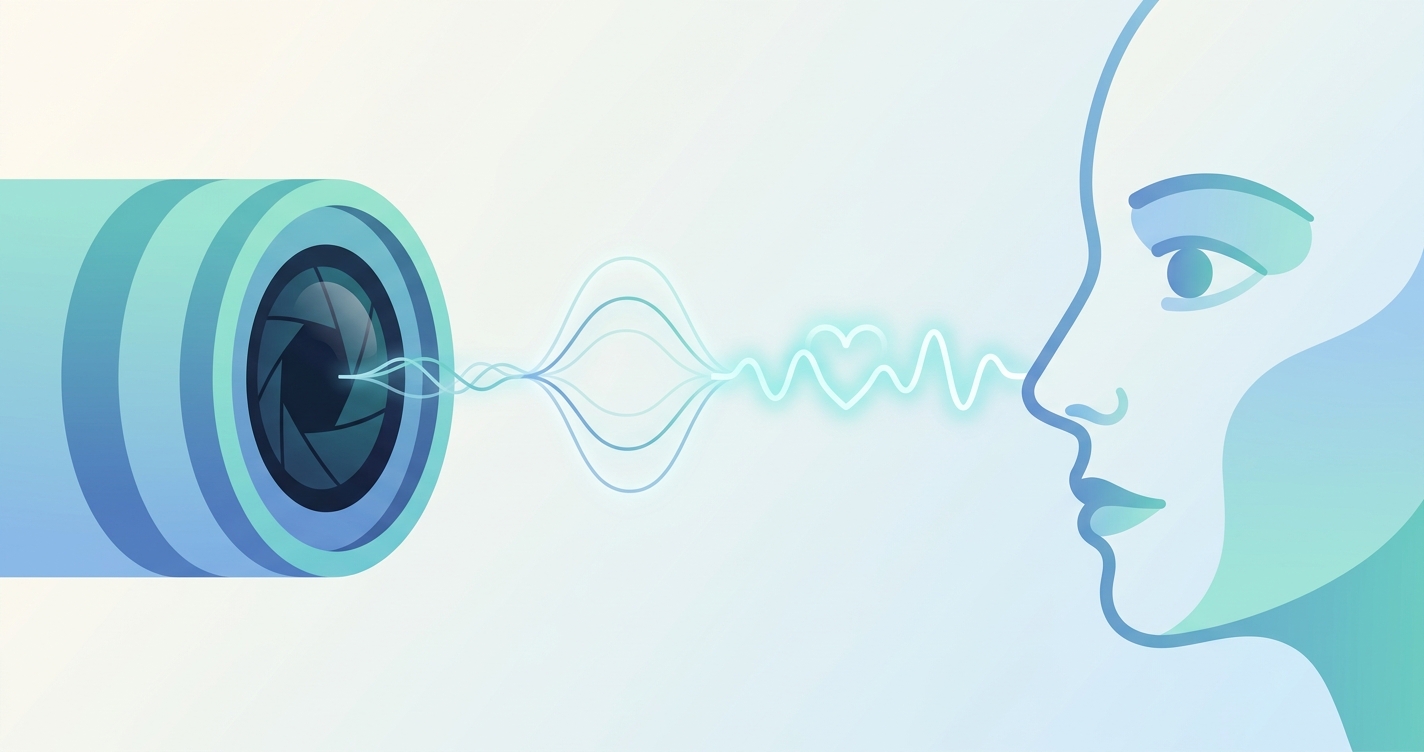
Hardware teams evaluating contactless health screening usually start with an optimistic assumption: if a camera can see a face, it can read everything a bedside monitor reads. The reality is more segmented. The set of vital signs a camera can measure today is real and growing, but it is not the full panel, and the gap between what is reliable and what is still experimental matters enormously for product scoping. Remote photoplethysmography (rPPG) extracts a pulse waveform from tiny color changes in skin captured by an ordinary RGB sensor, and from that single signal a surprising amount can be derived. The discipline for any device maker is knowing where the signal ends and where a cuff or clip still has to take over.
A 2024 systematic review of non-contact vision-based vital sign monitoring published in MDPI Electronics found that camera methods now estimate heart rate within a few beats per minute under controlled conditions, while blood pressure and oxygen saturation remain markedly less mature.
The vital signs a camera can measure today
The honest way to frame the vital signs a camera can measure is as a tiered list, ordered by how close each parameter sits to the raw rPPG waveform. Heart rate is the closest. Because the pulse waveform is, by definition, a record of cardiac cycles, deriving beats per minute is the most direct calculation in the whole pipeline. Heart rate variability sits one step further out, requiring clean beat-to-beat timing. Respiration rate can be recovered two ways: from the subtle modulation rPPG imposes on the pulse signal, and from direct motion analysis of the chest and shoulders. Beyond that, the inference chain gets longer and the error bars get wider.
Blood pressure and blood oxygen are the two parameters buyers ask about most, and they are exactly the two where the contactless picture is weakest. Both can be approximated from camera data, but neither currently matches the dedicated hardware that was purpose-built to measure them. A non-contact photoplethysmography mobile application study indexed on PubMed reported roughly 99 percent agreement with reference heart rate but only around 61 percent accuracy for systolic and 56 percent for diastolic blood pressure, a spread that tells the whole story about which readings are production-ready and which are research-stage.
| Vital sign | Camera (rPPG) maturity | Typical method | Still needs contact hardware? |
|---|---|---|---|
| Heart rate | High | Direct pulse waveform | No, for screening use |
| Respiration rate | Moderate to high | Pulse modulation plus chest motion | Sometimes, for clinical-grade |
| Heart rate variability | Moderate | Beat-to-beat interval timing | Depends on use case |
| Blood oxygen (SpO2) | Low to moderate | Multi-wavelength ratio estimation | Yes, finger clip still preferred |
| Blood pressure | Low | Waveform feature modeling | Yes, cuff still required |
| Body temperature | Separate sensor | Thermal imaging, not rPPG | Yes, needs IR camera |
A few practical takeaways follow from this hierarchy:
- Contactless heart rate and breathing rate are the dependable core of any camera-based screening feature.
- Touchless oxygen reading is feasible as a trend indicator but should not be marketed as a clinical SpO2 replacement.
- Camera blood pressure measurement is the most-requested and least-mature capability, and it carries the heaviest regulatory burden.
- Temperature is not an rPPG output at all; it requires a separate thermal sensor, which changes the bill of materials.
Why some vitals translate and others do not
Contactless heart rate and breathing rate
These two parameters work because they are periodic and because the camera is measuring the phenomenon almost directly. Heart rate is the dominant frequency in the pulse signal. Respiration rate shows up as a slower envelope riding on top of that signal, plus visible motion in the upper torso. A standard 30-frame-per-second sensor has more than enough temporal resolution to resolve both, which is why contactless heart rate breathing rate capture is the first feature most embedded platforms ship.
Camera blood pressure measurement
Blood pressure is not periodic in a way a camera sees directly. It has to be inferred from waveform morphology, pulse transit timing, and machine-learning models trained against cuff references. Researchers including those behind a 2024 arXiv exploratory study on estimating blood pressure with a camera in ambulatory cardiovascular patients have shown the signal carries usable information, but absolute accuracy across diverse populations, postures, and blood pressure ranges remains the open problem. For a device maker, this means camera blood pressure measurement belongs in a roadmap conversation, not a launch spec.
Touchless oxygen reading
SpO2 estimation depends on comparing how blood absorbs light at different wavelengths. A finger pulse oximeter controls the light path tightly; a room camera does not. The 2024 MDPI review on remote photoplethysmography for non-contact vital sign monitoring identifies motion artifacts, ambient and flickering light, and skin tone variation as the three forces that degrade touchless oxygen reading accuracy. Hybrid RGB plus near-infrared sensing is the most promising path, but it adds cost and complexity to the hardware design.
Industry Applications
Clinical kiosks and check-in stations
Self-service kiosks are the clearest fit for the reliable tier. A patient sits still for 30 to 60 seconds while the device captures heart rate, respiration rate, and heart rate variability, then hands off to a cuff module for blood pressure if a verified reading is required. This hybrid design lets manufacturers ship a contactless experience without overclaiming on the parameters that are not ready.
IoT and ambient devices
Smart displays, mirrors, and in-room sensors favor passive, periodic capture. Here the camera-friendly vitals shine because the use case is trend monitoring rather than diagnosis. An IoT platform tracking resting heart rate and breathing rate over weeks delivers value without ever needing cuff-grade blood pressure.
Telehealth and remote monitoring endpoints
Tablets and laptops already have cameras, which makes rPPG attractive for remote visits. The constraint is environment: home lighting and patient movement are uncontrolled, so the same parameters that work in a kiosk degrade at the edges, and the software has to surface signal-quality confidence rather than a single number.
Current research and evidence
The evidence base in 2024 and 2025 is consistent on one point: maturity is uneven across parameters. The MDPI systematic review of vision-based vital sign monitoring documents strong heart rate agreement and a clear accuracy cliff for blood pressure and SpO2. A separate analysis reported by News-Medical noted that rPPG heart rate accuracy can drop sharply at elevated heart rates, a reminder that even the strongest parameter has operating boundaries tied to physiology and motion.
Comparative findings worth holding onto:
- Heart rate from camera methods is frequently reported with mean absolute error under 3 beats per minute in controlled settings.
- Respiration rate accuracy commonly lands in the mid-80 percent range, usable for screening but not yet a ventilator substitute.
- Blood pressure agreement remains well below the threshold device makers would need for a measurement claim.
- Skin tone and lighting bias are now treated as primary validation requirements, not edge cases, across the recent literature.
This pattern explains why the smartest product strategies treat the camera as a multi-parameter screening front end paired with selective contact hardware, rather than as a wholesale replacement for it.
The future of camera-based vital signs
The trajectory points toward widening the reliable tier rather than a single breakthrough. Three developments are converging. First, multi-wavelength and near-infrared sensing should narrow the touchless oxygen reading gap by giving algorithms the spectral separation that ordinary RGB lacks. Second, larger and more demographically balanced training datasets are directly addressing the skin tone and lighting bias that has limited generalization. Third, edge-capable models are moving inference onto the device, which improves privacy and latency and makes embedded deployment practical at scale.
For blood pressure, expect incremental gains tied to better calibration workflows and personalized models rather than a sudden contactless cuff replacement. The parameters that already work will get more robust in motion and poor lighting first, because that is where the commercial demand and the available data both concentrate.
Frequently asked questions
Which vital signs can a camera measure most reliably? Heart rate is the most reliable, followed by respiration rate and heart rate variability. These derive closely from the pulse waveform that rPPG extracts, so they hold up well in controlled screening conditions.
Can a camera measure blood pressure without a cuff? Not yet at clinical accuracy. Camera blood pressure measurement is an active research area, but reported agreement with cuff references is still too low for a measurement claim, so a cuff remains necessary for verified readings.
Is touchless oxygen reading accurate enough to replace a finger clip? Not currently. Touchless oxygen reading can indicate trends, but motion, ambient light, and skin tone reduce accuracy. A finger pulse oximeter is still preferred when an exact SpO2 value matters.
Does camera-based monitoring work for all skin tones and lighting? Performance varies, and recent research treats skin tone and lighting bias as core validation requirements. Modern systems mitigate this with balanced training data and signal-quality confidence scoring, but it remains an engineering priority.
Circadify is building toward this segmented reality with an embedded rPPG engine designed to run the reliable contactless parameters on kiosks, tablets, and clinical hardware while integrating cleanly with contact sensors where they are still required. Device makers scoping a build can review the capabilities and hardware fit in the clinical kiosk integration guide.