What if your TV knew you were getting sick before you even felt symptoms?
Smart TV health alerts could turn the living room display into a passive screening device. A look at the rPPG, IoT, and integration realities for device makers.
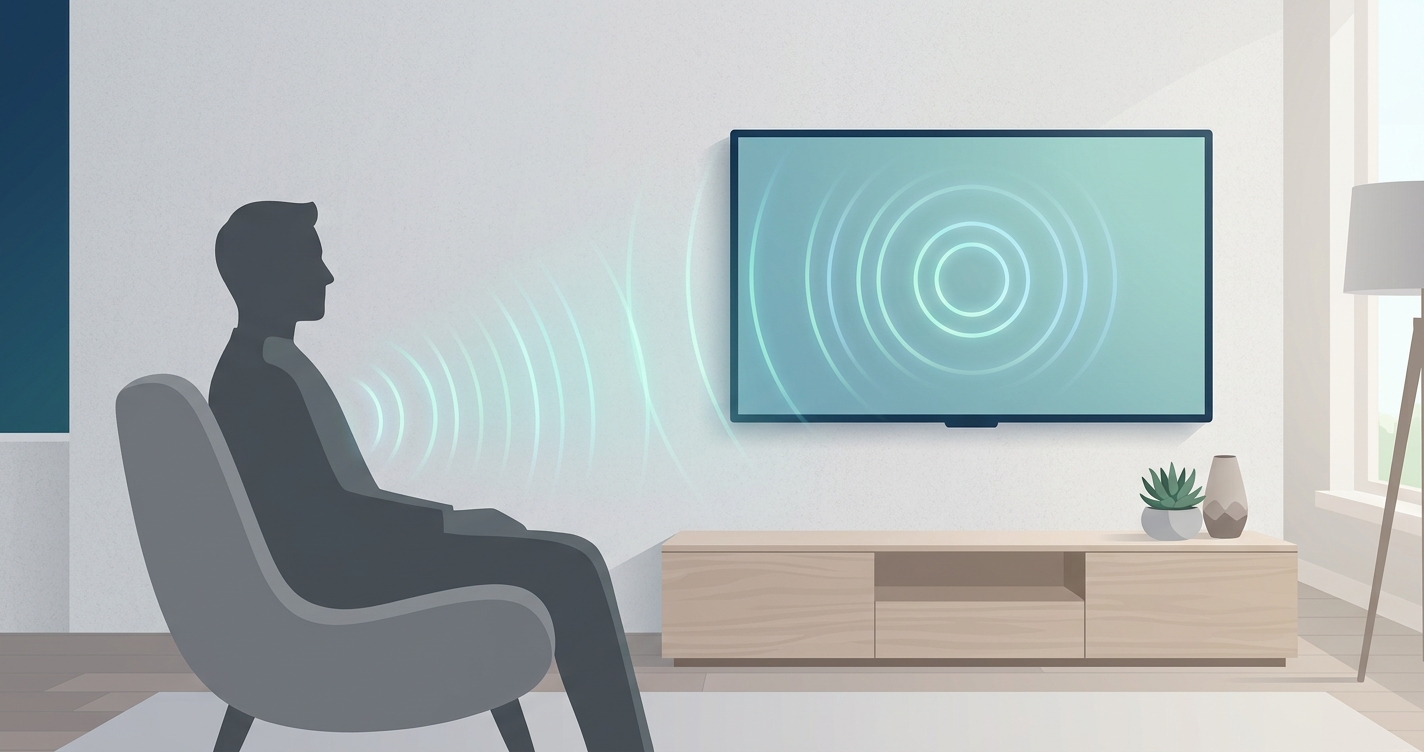
The average household watches its television for several hours a day, usually from the same couch, at roughly the same viewing distance, under the same lamp. For a sensor designer, that is an unusually consistent measurement setup hiding in plain sight. The idea behind smart TV health alerts is not that the screen becomes a diagnostic instrument, but that a device people already sit in front of every evening could quietly track subtle physiological trends and flag when something drifts away from a person's normal baseline. For medical device companies and IoT platform providers, the question is no longer whether the camera and compute exist in modern panels. They do. The question is whether the signal chain, the privacy model, and the alerting logic can be built responsibly enough to ship.
Stanford researchers led by Michael Snyder reported that wearable sensor data could detect physiological deviations associated with infection before participants reported symptoms, with elevated resting heart rate among the earliest signals. The same baseline-deviation principle is what makes ambient camera sensing on home screens worth examining.
Why smart TV health alerts are suddenly plausible
Smart TV health alerts depend on one core capability: extracting vital signs from a standard camera without contact. That capability is remote photoplethysmography, or rPPG. The technique reads tiny color changes in facial skin caused by blood volume pulsing through capillaries, then reconstructs a pulse waveform from those fluctuations. From that waveform a system can estimate heart rate, heart rate variability, and respiration rate, and increasingly researchers are extending the approach toward blood pressure trends and stress indicators.
Several factors have converged to make this realistic for living room hardware. Camera modules in premium panels and streaming bars now match the resolution and frame rates that rPPG algorithms need. Edge compute in modern TV systems-on-chip can run inference locally rather than streaming raw video to the cloud. And a 2024 clinical validation of rPPG-based contactless pulse monitoring in cardiovascular disease patients showed the method holding up outside laboratory conditions, which is the threshold device makers care about most.
The early-warning layer sits on top of the raw measurement. A single heart rate reading means little. A two-week trend showing resting heart rate creeping up, sleep-adjacent recovery worsening, or respiration rate shifting is what actually carries predictive value. That is the same logic the Snyder lab and later wearable studies used to surface presymptomatic signals.
How the home screen compares to other ambient sensing surfaces
A smart TV is one of several surfaces competing to host passive health sensing in the home. Each has a different geometry, duty cycle, and integration cost. The comparison below frames the tradeoffs device teams weigh.
| Sensing surface | Typical viewing distance | Session length | Lighting control | Integration challenge |
|---|---|---|---|---|
| Smart TV | 2 to 4 meters | Long, often 1 to 3 hours | Variable, often dim | Distance reduces facial pixel density |
| Tablet or smart display | 0.3 to 0.8 meters | Short, intermittent | Moderate | Best signal, lowest dwell time |
| Smart mirror | 0.3 to 0.6 meters | Short, routine-based | Good, often front-lit | Limited installed base |
| Laptop or monitor | 0.5 to 0.8 meters | Long, work hours | Moderate to good | Strong for daytime, not evenings |
| Wearable (optical) | Contact | Continuous | Not applicable | Requires user compliance |
The TV's strength is dwell time. No other ambient surface holds a relaxed, seated, forward-facing subject for as long. Its weakness is distance. At three meters the face occupies far fewer pixels than it does on a tablet held at arm's length, which lowers the signal-to-noise ratio the rPPG engine has to work with. That single tradeoff shapes most of the engineering decisions downstream.
Key constraints a smart TV health alerts pipeline has to solve:
- Recovering a clean pulse signal from a small, distant facial region under low and shifting ambient light.
- Separating motion artifacts from genuine physiology when the viewer talks, eats, or shifts position.
- Handling multiple people on a couch and attributing readings to the right individual.
- Building a personal baseline over days and weeks rather than reacting to single noisy readings.
- Keeping raw video on-device so the system never transmits identifiable imagery.
Industry applications for device makers and IoT platforms
Medical device companies
For regulated device makers, the appealing path is not a standalone TV product but an embedded vitals module that turns an existing panel into a screening endpoint. A trend-monitoring feature that nudges a user toward a clinician when their baseline shifts is a lighter regulatory proposition than a diagnostic claim, and it pairs naturally with remote patient monitoring programs that already reimburse for physiologic data collection. The engineering work is mostly in validating the rPPG signal chain at TV viewing distances and documenting it under a software lifecycle framework.
IoT platform providers
Platform companies see the TV as one node in a whole-home health mesh. The same embedded rPPG engine that runs on a clinical kiosk or a tablet can run on a smart display or a streaming device, feeding a shared baseline model. The value is continuity: a reading from the bathroom mirror in the morning and the living room screen at night describe the same person across the day, which makes deviation detection far more reliable than any single device acting alone.
Consumer electronics and OEMs
For TV and set-top OEMs, health sensing is a differentiation feature that does not require new silicon if the camera and edge compute are already present. The realistic near-term offering is wellness framing, not clinical framing: gentle trend summaries, stress check-ins during long sessions, and an opt-in early-warning notification rather than a medical alert.
Current research and evidence
The evidence base for the underlying measurement is maturing quickly. A 2024 study integrating rPPG with machine learning on a multimodal dataset reported improved heart rate accuracy specifically by compensating for environmental lighting and skin pigmentation, two of the conditions that most degrade living room performance. Review work in the field, including analyses of deep learning approaches to contactless physiological measurement, points to consistent gains in motion and low-light robustness as neural models replace older signal-processing-only pipelines.
The early-detection rationale rests on separate but reinforcing work. Beyond the Stanford wearable findings, systematic reviews published in 2023 examined wearable sensors for early detection of infectious disease and passive home monitoring for detecting health deterioration in older adults. Both concluded that continuous baseline tracking can surface deviations earlier than episodic checks, while flagging the same open issues that apply directly to TVs: detection accuracy in real homes, data privacy, and integration into care workflows.
What the literature does not yet provide is large-scale validation of rPPG at true television distances across diverse skin tones and lighting. That gap is the most important one for any team planning a product, because evening living room conditions are close to a worst case for camera-based sensing.
The future of smart TV health alerts
The trajectory points toward sensor fusion rather than a hero TV sensor. A screen that occasionally captures a clean facial pulse, combined with presence and motion data and readings from other ambient surfaces, can build a household health picture no single device delivers. Expect the alerting layer to grow more conservative and more personalized, learning each viewer's normal range before it ever raises a flag, to keep false alarms from eroding trust.
Privacy architecture will define which products survive. On-device inference that converts video to vital-sign numbers and discards the frames is likely to become the default expectation, not a premium feature. The companies that win this space will be the ones that treat the living room camera as a strictly local sensor and design the data path to prove it.
The likely first wave is wellness-grade trend tracking with clear opt-in, followed by clinically framed remote monitoring once distance-specific validation catches up. For device and platform teams, the strategic move now is choosing an embedded vitals engine that ports cleanly across kiosks, tablets, and displays, so the same validated signal chain can follow the user from clinic to couch.
Frequently asked questions
Can a smart TV actually measure vital signs from across the room?
A camera-equipped TV can run rPPG to estimate heart rate and related signals, but the long viewing distance reduces facial pixel density and signal quality compared with a tablet held close. It is feasible for trend tracking under reasonable lighting, and it benefits heavily from machine learning models tuned for low-light, distant capture.
How could a TV warn you about illness before symptoms appear?
The mechanism is baseline deviation, not diagnosis. By tracking metrics like resting heart rate and respiration over days, the system can flag when readings drift from your normal range. Stanford research showed that resting heart rate elevation can precede self-reported symptoms, which is the principle these alerts would apply.
Is the video sent to the cloud?
A responsibly designed system runs rPPG inference on the device and transmits only derived numbers, never raw facial video. On-device edge processing is becoming the expected privacy model for ambient health sensing in the home.
What does this mean for medical device and IoT companies?
The practical opportunity is an embedded rPPG module that adds passive trend monitoring to hardware people already own, framed as wellness or remote monitoring rather than diagnosis. The main work is validating the signal chain at TV distances and documenting it under an appropriate software lifecycle.
Circadify is building toward this space with an embedded rPPG engine designed to run across kiosks, tablets, smart displays, and other clinical hardware, so a single validated signal chain can follow a user from the waiting room to the living room. Teams evaluating how to bring contactless vitals into their own devices can review the hardware integration guide for clinical kiosks to see how the same engine maps onto different form factors.