Can your smart home hub measure your breathing rate while you sleep?
How everyday smart home devices could become a contactless sleep monitor that tracks breathing rate overnight, and what IoT platform providers need to know.
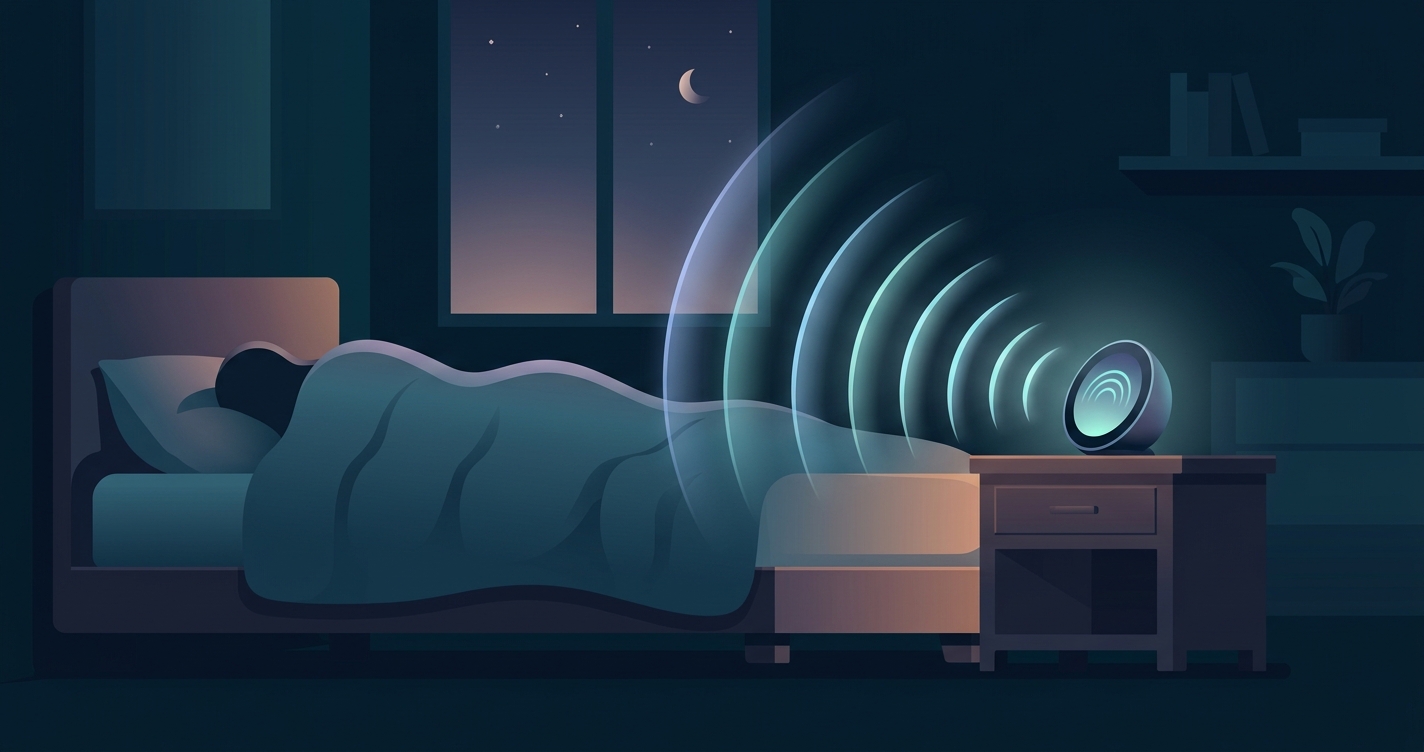
The smart home hub on a nightstand already has most of the parts a contactless sleep monitor would need: a camera or radio, a processor, a network connection, and a fixed view of a person who stays mostly still for seven or eight hours. That overlap is why IoT platform providers keep returning to the same question. If a device is already watching a bedroom, can it quietly measure breathing rate during sleep without adding a wearable, a chest band, or a separate purchase? The short answer from the current research is that the signal is there and it is recoverable. The harder answer is that turning a consumer hub into a dependable respiratory sensor is an engineering and validation problem, not a firmware toggle.
A digital health evaluation study published in JMIR mHealth and uHealth (Ravindran et al., 2024) reported that contactless bedside and under-mattress systems tracked overnight breathing rate with a mean absolute error of 1.6 breaths per minute or better against reference monitoring in older adults.
Why a contactless sleep monitor is suddenly plausible
A contactless sleep monitor estimates respiration by detecting the small, periodic changes a breathing body produces. There are three signal sources that fit inside existing smart home hardware. Radar and Wi-Fi sensing pick up the millimeter-scale chest and abdomen motion of each breath. Camera-based remote photoplethysmography (rPPG) reads subtle color and motion changes in skin and the upper body, and respiration appears both as a direct motion signal and as a modulation of the pulse waveform. Each of these can run on hardware that platform providers already ship.
Sleep is, counterintuitively, one of the friendlier conditions for these methods. The subject is stationary, lighting is controlled or absent, and the measurement window is long enough that an algorithm can average across many breaths and reject noisy segments. The classic failure modes of daytime contactless vitals, which are motion and changing illumination, are largely absent at 3 a.m.
The trade-off is sensing modality. Cameras need usable light or near-infrared illumination and a line of sight to skin or bedding. Radar works in total darkness and through a blanket but gives motion only, not the optical pulse signal. Wi-Fi sensing reuses existing radios but is the most sensitive to room layout and interference. For an IoT platform deciding where to put a respiratory feature, that choice shapes everything downstream.
| Sensing approach | Existing hub hardware reused | Works in full darkness | Direct breathing signal | Main limitation |
|---|---|---|---|---|
| Camera rPPG (visible/NIR) | Smart display, security cam, doorbell-class sensor | With NIR illuminator | Motion plus pulse-derived respiration | Needs line of sight and usable light |
| Doppler / UWB radar | Dedicated radio module | Yes | Chest and abdomen motion | Motion only, no optical pulse |
| Wi-Fi channel state info | Existing Wi-Fi radio | Yes | Motion via signal perturbation | Sensitive to room layout, interference |
| Under-mattress / load sensor | Add-on strip sensor | Yes | Ballistic and breathing motion | Not contactless from the hub itself |
- Camera rPPG is the most natural fit for devices that already have an imaging sensor and a screen, such as a smart display.
- Radar is preferred when privacy optics matter, because it captures no image.
- Wi-Fi sensing is the cheapest to deploy because it adds no bill-of-materials cost, at the price of harder calibration.
- Under-mattress approaches sidestep optics entirely but break the promise of a single hub doing the work.
Industry applications for IoT platforms
For platform providers, the interesting move is not building a standalone sleep gadget. It is adding a passive respiratory feature to a device the household already owns and already trusts on the nightstand or wall.
Smart displays and bedside hubs
A bedside smart display has a camera, a capable SoC, and a fixed framing of the bed. That is close to an ideal contactless sleep monitor platform. An embedded rPPG pipeline can run on-device, derive a nightly breathing-rate trend, and surface a simple morning summary without sending video anywhere. Keeping inference at the edge is also the cleanest answer to the privacy objection that a bedroom camera always raises.
Ambient and elder-care monitoring
Continuous overnight breathing data is most valuable where a wearable is least likely to be worn. Older adults, post-discharge patients, and people who simply will not sleep in a band are the populations where a contactless approach earns its place. A hub that flags a gradual change in resting respiratory rate over weeks gives a care platform something a single clinic visit cannot.
Existing security and presence sensors
Many platforms already run cameras and radio sensors for security and occupancy. Respiration estimation can ride on that installed base as a software feature rather than new hardware, which changes the economics. The constraint is that consumer-grade optics and placement were chosen for a different job, so signal quality varies widely and the firmware has to be honest about when a reading is unreliable.
Current research and evidence
The peer-reviewed picture has moved from proof of concept toward measured agreement against clinical references. The JMIR mHealth and uHealth evaluation (Ravindran et al., 2024) found that bedside and under-mattress contactless systems held breathing-rate error to roughly 1.6 breaths per minute or better across full nights of sleep in an aging cohort. A clinical validation of a contactless radar respiration monitor reported in the journal literature (van Gastel and colleagues, 2023) measured a mean absolute error near 0.4 breaths per minute against a thoracic effort band in controlled conditions and under 0.5 across whole-night recordings.
On the optical side, a Sensors review of non-contact photoplethysmography methods for respiratory rate estimation (2023) confirmed that respiration can be recovered both from body motion and from modulation of the rPPG pulse signal, with morphological feature extraction improving stability. A 2024 survey in an RSC journal on contactless vital-sign monitoring catalogued radar, Wi-Fi, and camera approaches and reached a consistent conclusion: heart rate and respiration during sleep are recoverable across all three modalities, and the differentiator is robustness in real homes rather than peak accuracy in a lab.
Two caveats run through this literature. First, reported error figures come from defined cohorts and setups, so they do not transfer automatically to an arbitrary consumer hub in an arbitrary bedroom. Second, breathing rate is one metric. Detecting clinically meaningful events such as apneic pauses is a harder bar that most consumer-grade contactless systems do not clear without dedicated validation.
The future of contactless sleep monitoring
The direction of travel is toward respiration becoming a passive, ambient output of devices bought for other reasons, rather than a feature people shop for. Three shifts will decide how fast that happens for IoT platforms.
- Edge inference will be the default. Running the pipeline on-device keeps raw video and radio data in the home and makes the privacy story defensible, which matters more in a bedroom than anywhere else.
- Sensor fusion will replace single-modality bets. Combining a camera signal with a radio signal lets a hub cross-check a noisy night and report confidence instead of a guess.
- Regulatory framing will sharpen. Wellness trend reporting and medical-grade respiratory monitoring are different products with different evidence requirements, and platforms will have to choose a lane early because it dictates validation cost and claims.
For an IoT platform, the realistic near-term play is a wellness-grade nightly breathing trend with conservative confidence reporting, built on an embedded engine that runs at the edge and degrades gracefully when conditions are poor.
Frequently asked questions
Can a normal smart home hub really measure breathing rate without any wearable?
The underlying signal is recoverable with the camera or radio a hub already contains, and peer-reviewed studies show breathing-rate error in the range of roughly 0.4 to 1.6 breaths per minute for purpose-built contactless systems. A general consumer hub will perform somewhere below that benchmark unless its optics, placement, and software are tuned for the task.
Is camera-based monitoring a privacy problem in the bedroom?
It is the first objection every time, which is why edge processing matters. An rPPG pipeline that derives only a breathing number on-device, never stores or transmits video, and lets users disable the camera addresses most of the concern. Radar-based approaches avoid imaging entirely for buyers who want that guarantee.
Can a contactless sleep monitor detect sleep apnea?
Estimating resting breathing rate is well supported in the literature. Reliably detecting apneic events is a substantially harder problem that requires dedicated validation and usually a clearer regulatory pathway, so most consumer-grade systems should not make that claim without it.
What does an IoT platform need to add this feature?
A camera or radio sensor with adequate signal quality, enough on-device compute for real-time inference, and an embedded vitals engine that handles signal extraction, artifact rejection, and confidence scoring. The hardware is often already present; the engine and the validation work are what determine whether the feature is trustworthy.
Circadify is working on exactly this layer, an embedded rPPG engine designed to run on smart displays, kiosks, tablets, and clinical hardware rather than a single fixed product. IoT platform providers evaluating how a contactless sleep monitor could fit an existing ecosystem can review the technical path in our hardware integration guide at https://circadify.com/custom-builds/clinical-kiosks.