
Does Skin Tone Affect Contactless Vitals Accuracy?
An evidence review of skin tone contactless vitals accuracy, camera vitals bias, and how modern rPPG systems correct for melanin to support inclusive health screening.
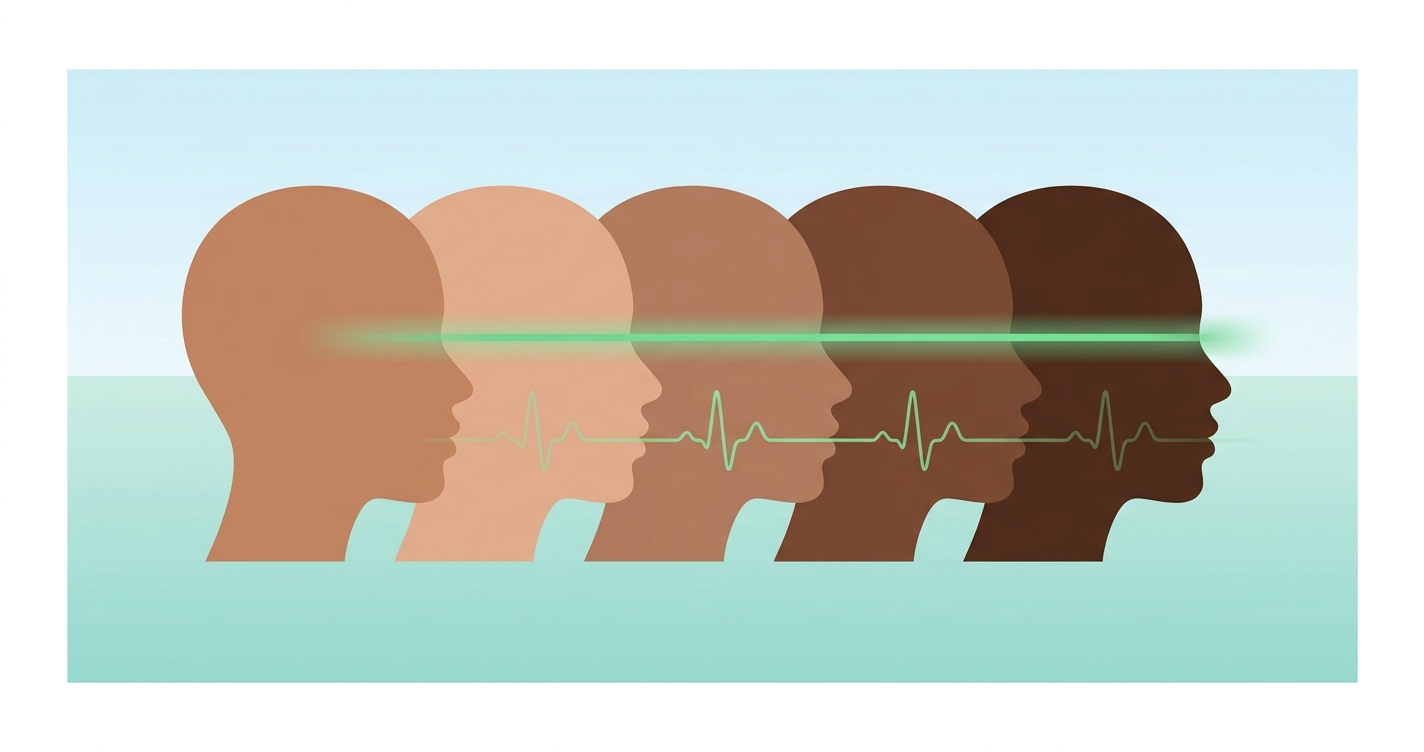
Every hardware team scoping a camera-based vitals feature eventually hears the same question from a clinical advisor or a procurement officer: will it work the same on dark skin as it does on light skin? The concern is reasonable and well documented. Contact pulse oximeters carry a measurable racial bias, and any optical method that reads physiology through the skin inherits the same physics problem. Skin tone contactless vitals accuracy is now a gating requirement for medical device companies, kiosk manufacturers, and IoT platform providers, not an afterthought to be patched later. The good news for engineering teams is that the bias is understood, measurable, and correctable, but only if it is designed for from the start rather than discovered in the field.
A 2020 study by Michael Sjoding and colleagues at the University of Michigan, published in the New England Journal of Medicine, found that Black patients had nearly three times the rate of occult hypoxemia missed by pulse oximeters compared with white patients, across a cohort of 1,333 patients.
Why skin tone affects contactless vitals accuracy
Remote photoplethysmography, or rPPG, estimates pulse and related vitals by detecting tiny color changes in the skin as blood volume rises and falls with each heartbeat. A camera captures reflected light, and an algorithm isolates the periodic signal buried in that reflection. Melanin, the pigment that determines skin tone, absorbs and scatters light, with the strongest effect in the green wavelengths that many photoplethysmography methods rely on. More melanin means more of the incoming light is absorbed before it can interact with blood in the dermis, which lowers the strength of the pulsatile signal that reaches the sensor.
The result is a weaker signal-to-noise ratio for darker skin tones. That does not automatically mean wrong readings, but it does mean the algorithm has less margin to work with. Under good lighting, a well-designed system can still extract a clean pulse. Under poor lighting, motion, or a short capture window, the gap between light and dark skin widens. This is the core of what researchers call camera vitals bias: the error distribution is not uniform across the population, and the people most likely to be underserved are those with the most melanin.
It is worth separating two distinct sources of error. The first is physical, driven by optics and melanin. The second is statistical, driven by training data. Many publicly available rPPG datasets underrepresent darker skin tones, so models trained on them learn patterns that fit lighter skin better. A 2023 analysis of demographic bias in public rPPG datasets confirmed this skew, and work by Krish Kabra and collaborators on diverse rPPG showed that synthetic augmentation and rebalanced training can narrow the heart rate estimation gap across skin tones.
| Factor | Effect on darker skin tones | Engineering mitigation |
|---|---|---|
| Melanin light absorption | Reduces pulsatile signal strength, lowers signal-to-noise ratio | Use red and infrared wavelengths alongside green; adaptive gain |
| Lighting conditions | Poor or uneven light amplifies the signal gap | Controlled illumination in kiosk enclosure; ambient light sensing |
| Training data imbalance | Models underfit underrepresented skin tones | Balanced datasets, synthetic augmentation, per-subgroup validation |
| Capture window length | Short windows leave less signal to recover | Longer or adaptive capture; quality-gated retries |
| Camera dynamic range | Detail lost in low-reflectance regions | Higher bit-depth sensors, tuned exposure control |
The table makes the central point clear: most of the bias is addressable through hardware and software choices that a device integrator controls. Skin tone is a physics challenge, not a verdict.
What inclusive health screening requires from a device
Building for inclusive health screening means treating skin tone as a first-class test variable rather than a demographic footnote. The teams that get this right tend to share a few practices.
- Validate across a standardized skin tone scale rather than coarse race categories. The Monk Skin Tone Scale, a 10-shade scale, and objective measures such as individual typology angle give reproducible bins.
- Report error metrics per skin tone subgroup, not just a single population-wide mean that can hide a large tail.
- Design the optical path and lighting together, since IoT health sensor accuracy depends as much on illumination as on the algorithm.
- Use multiple wavelengths where possible, because red and infrared penetrate more deeply and are less attenuated by melanin than green.
- Gate results on signal quality so the device can ask for a retry rather than report a confident but unreliable number.
Industry Applications
Clinical kiosks
Self-service clinical kiosks see the widest demographic range of any deployment, often in public and unsupervised settings. A kiosk that quietly performs worse for a subset of users creates both a clinical risk and a reputational one. Because a kiosk controls its own enclosure, it can also control lighting, camera placement, and capture distance, which makes it one of the better environments to engineer out camera vitals bias. Contactless vitals device integration at the kiosk level should bundle illumination design with the rPPG engine rather than treating them separately.
IoT platforms and smart displays
IoT platform providers face the opposite constraint: they ship software onto hardware they do not fully control, under lighting they cannot guarantee. Here the burden shifts to robust algorithms, ambient light sensing, and conservative quality gating. An embedded rPPG system that reports its own confidence and declines low-quality captures protects accuracy across skin tones even when the physical environment is imperfect.
Tablets and check-in hardware
Front-of-house tablets used for patient check-in tend to use commodity front cameras with limited dynamic range. For these, sensor selection and exposure tuning matter disproportionately, because lost detail in low-reflectance skin regions cannot be recovered downstream. Teams integrating vitals into existing tablet fleets should benchmark the actual camera modules against a diverse panel before committing.
Current research and evidence
The contact pulse oximetry literature set the agenda. The Sjoding study in 2020 made the bias undeniable, and the U.S. Food and Drug Administration responded with a safety communication and, in subsequent draft guidance, recommendations to raise the minimum clinical study size from 10 to 150 participants and to assess skin tone using both the Monk Skin Tone Scale and objective measures such as individual typology angle. The FDA also proposed labeling that indicates whether a device performs comparably across diverse skin pigmentations, a signal that subgroup performance is becoming a marketable and auditable property.
On the contactless side, the evidence is more encouraging than the early framing suggested. A peer-reviewed evaluation of photoplethysmography across diverse skin tones in smartwatch monitoring, published in 2024, found that error varied substantially by device, with some hardware showing minimal heart rate error across skin tones while others underestimated heart rate in darker-skinned users. The lesson is that bias is an implementation property, not an inherent limit of the technology. A UCLA team has demonstrated methods to reduce remote heart rate bias against darker skin, and SPIE-published work on polarized light has shown accuracy gains for wearable sensors across all skin tones. Together these results point to a consistent conclusion: with balanced data, multi-wavelength sensing, and disciplined validation, the gap can be brought within clinically useful bounds.
The Future of skin tone contactless vitals accuracy
The trajectory is toward measurement and accountability. Expect subgroup performance reporting to move from optional to expected, mirroring the direction of pulse oximeter regulation. Standardized skin tone scales will become part of validation protocols by default, and procurement checklists will start asking vendors for per-shade error tables rather than a single accuracy figure. On the engineering side, multi-wavelength and multi-modal sensing, including the fusion of camera and radar signals, will keep narrowing the physical signal gap. Synthetic data generation will help close the data imbalance that drives statistical bias. The devices that win clinical trust will be the ones that can show, with evidence, that they perform comparably for every user who steps in front of them.
Frequently asked questions
Does darker skin make contactless vitals readings unusable? No. Darker skin reduces the optical signal strength, which makes the engineering harder, but well-designed systems using balanced training data, multi-wavelength sensing, and good lighting can achieve comparable accuracy. The difference between a biased and an unbiased device is implementation, not skin tone itself.
How should a manufacturer test for camera vitals bias? Validate against a standardized skin tone scale such as the Monk Skin Tone Scale, recruit a panel that fills every shade bin, and report error metrics for each subgroup separately. A single population-wide accuracy number can hide a large error tail for underrepresented groups.
Why are contact pulse oximeters biased, and does that apply to cameras? Both rely on light passing through pigmented skin, so melanin absorption affects both. The 2020 Sjoding study quantified the pulse oximeter bias. Cameras share the underlying physics, but because integrators control lighting, wavelengths, and algorithms, the bias is correctable by design.
What role does lighting play in inclusive health screening? A large one. Poor or uneven lighting widens the accuracy gap between light and dark skin. Kiosks that control their own enclosure lighting have a structural advantage, while open-environment devices must lean on ambient light sensing and quality gating.
For medical device companies, kiosk manufacturers, and IoT platform providers building toward inclusive health screening, bias-tested vitals are no longer optional. Circadify is addressing this space with an embedded rPPG engine designed for any device, from kiosks to tablets to clinical hardware, with validation practices built around diverse skin tones. To see how contactless vitals device integration handles skin tone in practice, review the hardware integration guide at circadify.com/custom-builds/clinical-kiosks.