
How to Send Kiosk Vitals to Patient Health Records
A technical guide for device makers on how to send kiosk vitals to health records securely using FHIR, HL7, and IHE PCD-01 standards.
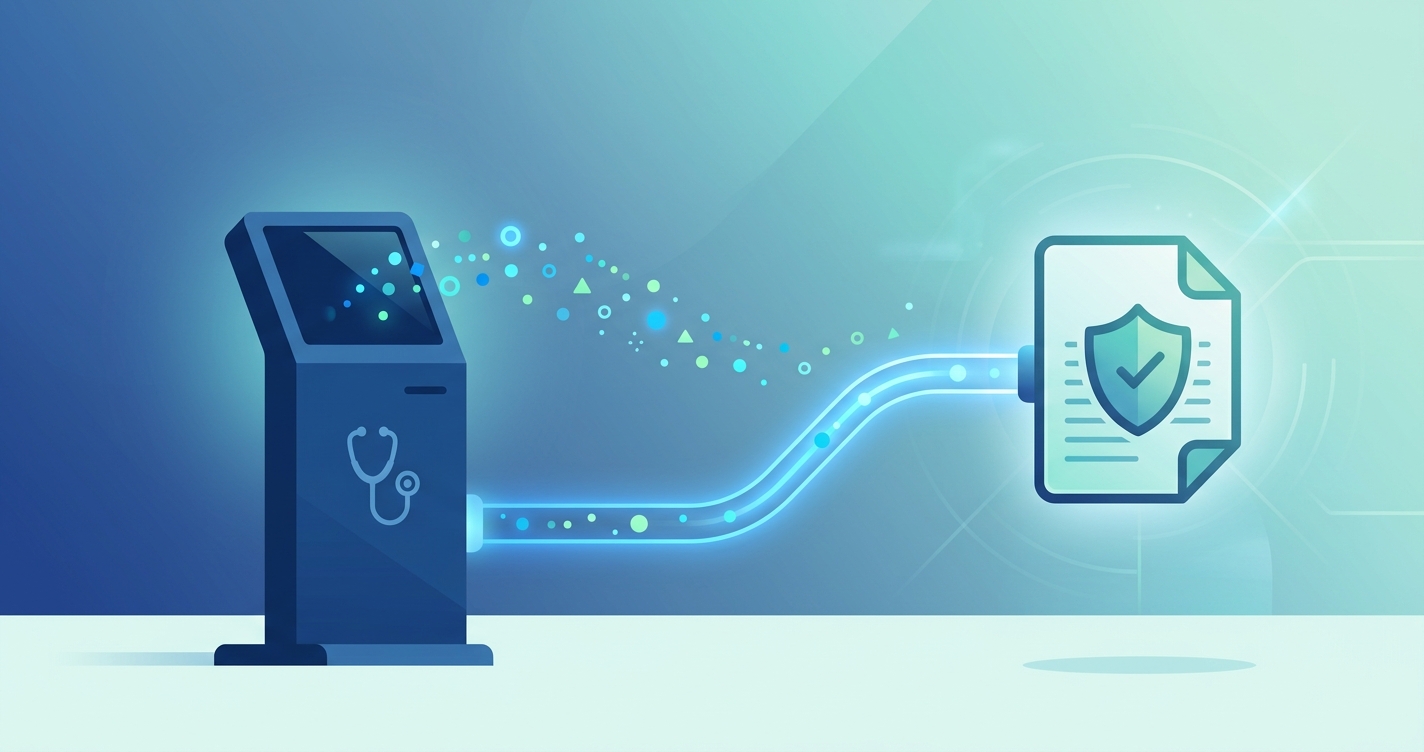
A clinical kiosk that measures a clean set of vital signs and then strands them on a local screen has solved the easy half of the problem. For medical device companies and kiosk manufacturers, the value of a screening station is not the measurement itself but where that measurement ends up. The ability to send kiosk vitals to health records reliably, with the right patient identity, units, and timestamps, is what separates a demo from a deployable product. Hospitals do not buy hardware that creates more manual data entry. They buy hardware that writes structured observations directly into the systems their clinicians already use.
The 21st Century Cures Act now requires certified health IT to expose FHIR-based application programming interfaces, and the US Core Implementation Guide v9.0.0 defines a dedicated Vital Signs Profile that any conforming observation must meet. That regulatory pressure has turned EHR write-back from a custom integration project into a standards-driven expectation.
How to send kiosk vitals to health records
To send kiosk vitals to health records, a device has to do three things in order: capture a measurement with provenance, map it to a standardized clinical vocabulary, and transmit it over an authenticated channel into the receiving system. Each step has its own failure modes, and most integration projects stall on the middle step rather than the transport.
The capture layer is where embedded vitals monitoring lives. Whether the signal comes from a cuff, a contact sensor, or an embedded rPPG engine reading the face, the kiosk needs to attach metadata to every reading: which patient, which device, what time, and under what measurement conditions. Without that provenance, downstream systems cannot trust the value, and clinicians will not act on it.
The vocabulary layer is where most data exports break. A heart rate of 72 means nothing to an electronic health record unless it arrives tagged with a LOINC code, a UCUM unit, and a profile that the receiver recognizes. The HL7 FHIR Observation resource, constrained by the US Core Vital Signs Profile, is the current target for this in the United States. Older hospital interfaces still rely on HL7 v2 messages, which is why the IHE Patient Care Device profile PCD-01 remains widely deployed.
The transport layer covers authentication, encryption, and delivery guarantees. A RESTful FHIR API call over TLS with an OAuth 2.0 token is the modern default. The harder engineering question is what happens when that call fails, which is where reliable queueing matters more than the protocol choice.
| Integration approach | Underlying standard | Best fit | Real-time capability | Engineering effort |
|---|---|---|---|---|
| FHIR REST API write-back | HL7 FHIR R4 + US Core | Modern EHRs, cloud platforms | High, near real-time | Moderate |
| HL7 v2 messaging | IHE PCD-01 (HL7 v2) | Legacy hospital interfaces | Medium, message-driven | High |
| Device gateway / middleware | Mixed (FHIR + HL7 v2) | Mixed fleets, multi-site rollouts | High | Moderate to high |
| Flat-file vitals data export | CSV / CCD documents | Batch reconciliation, research | Low, batch only | Low |
| Direct database write | Proprietary | Single-vendor closed systems | High | Low but brittle |
The table makes the trade-off visible. A direct database write is the fastest path to a working demo and the worst path to a maintainable product, because it couples the kiosk to one vendor's schema. A standards-based FHIR or PCD-01 integration costs more upfront and survives EHR upgrades, multi-site rollouts, and procurement reviews.
Designing the vitals data export pipeline
A robust kiosk EHR integration treats data export as a pipeline with explicit stages rather than a single API call. The stages that matter:
- Patient matching, so the reading attaches to the correct record using a medical record number, a scanned wristband, or a verified check-in identity.
- Coding and normalization, converting raw values to LOINC-coded, UCUM-unit observations that conform to a vital signs profile.
- Local buffering, so a dropped network connection never discards a captured measurement.
- Acknowledgement handling, confirming the receiving system accepted the observation before the kiosk marks it as delivered.
- Audit logging, recording who, what, and when for every transmitted reading.
Skipping the buffering and acknowledgement stages is the most common reason clinical kiosk health screening pilots lose data in the field. A kiosk in a busy lobby will lose connectivity, and a pipeline that assumes a perfect network will silently drop vitals.
Patient identity is the hardest part
Measuring a pulse is a solved problem. Knowing whose pulse it is, in a self-service setting where no clinician is supervising, is not. Most failed deployments trace back to identity, not measurement. Options range from barcode and QR scanning at check-in to integration with the facility's enterprise master patient index. The safest design refuses to transmit an observation it cannot confidently attribute, holding it for manual reconciliation instead of guessing.
Units, codes, and profile conformance
The FHIR specification defines profiles for common vital signs including heart rate, blood pressure, body temperature, respiratory rate, and oxygen saturation, each bound to a specific LOINC code. When a device claims to support vital signs, the receiver expects conformance to the Vital Signs Base profile. Blood pressure is the classic trap: it is a single observation with two component readings, systolic and diastolic, not two separate observations. Getting that structure wrong causes silent rejections that are painful to debug.
Industry Applications
Hospital and health system lobbies
Large health systems standardize on a single EHR, and their integration teams expect either a FHIR endpoint or an HL7 v2 feed through their existing interface engine. For these buyers, IHE PCD-01 conformance is a familiar checkbox, because it is the same profile their bedside monitors already use. A kiosk that speaks the same language as the monitors slots into existing workflows without a new interface build.
Retail and pharmacy screening
Retail clinics and pharmacy screening stations rarely have a hospital-grade interface engine. Here a cloud-based FHIR API or a vendor middleware layer that aggregates readings and forwards them is the practical pattern. The medical device data integration challenge shifts from protocol to scale, since a national retail footprint means thousands of endpoints reporting to a central platform.
Remote and occupational health
Employer health programs and remote monitoring deployments often need vitals data export into platforms that are not traditional EHRs at all. Flexible output formats matter most here, because the receiving system might be a population health dashboard rather than a clinical record.
Current research and evidence
A 2023 systematic review of vital signs-based healthcare kiosks for screening chronic and infectious diseases, published in a PMC-indexed journal, found that integration with hospital information systems and EHRs was a recurring determinant of whether kiosk programs sustained beyond pilot phase. Stations that synced data automatically saw higher clinical adoption than those requiring manual transcription.
On the standards side, the IHE Patient Care Device Technical Framework continues to define PCD-01 as the device-to-enterprise communication profile, validated each year at IHE Connectathon events where vendors test real interoperability against multiple EHR implementations. In parallel, the 2024 Draft Federal FHIR Action Plan signaled coordinated federal movement toward FHIR-based exchange across agencies and payers, reinforcing FHIR R4 and US Core as the forward-looking target for new device integrations. The practical reading for hardware teams is that both standards will coexist for years, and a serious product needs a path to both.
The future of kiosk vitals integration
Three shifts are reshaping how devices send kiosk vitals to health records. First, FHIR write-back is moving from optional to expected as Cures Act API mandates take full effect, which lowers the barrier for new entrants but raises the conformance bar. Second, edge processing is pushing more normalization and coding onto the device itself, so the kiosk emits a clean, profile-conformant observation rather than raw numbers that a server has to interpret. Third, embedded contactless sensing is expanding the set of measurements a kiosk can capture without disposables, which makes the integration question more urgent because there is simply more data to route.
The devices that win procurement will be the ones that treat integration as a first-class feature rather than a post-launch afterthought. An embedded vitals engine that ships with standards-conformant output already wired in removes the single biggest source of deployment delay.
Frequently asked questions
What data standard should a kiosk use to send vitals to an EHR?
For new deployments, HL7 FHIR R4 constrained by the US Core Vital Signs Profile is the recommended target, because it is mandated by Cures Act API rules and supported by modern EHRs. For hospitals running legacy interface engines, IHE PCD-01 over HL7 v2 is still widely required. A device that supports both covers the most ground.
How do you keep kiosk vitals secure in transit?
Transmit over TLS-encrypted connections, authenticate API calls with OAuth 2.0 tokens, attach a verified patient identifier to every observation, and maintain an audit log of all transmissions. On-device processing of raw sensor data, before any export, further reduces the amount of sensitive information that ever leaves the kiosk.
Why do kiosk vitals get rejected by the receiving system?
The most common causes are missing or incorrect LOINC codes, wrong units, malformed blood pressure structures that split components into separate observations, and unmatched patient identifiers. Conforming strictly to the vital signs profile and validating against the receiver's implementation guide before go-live prevents most rejections.
Can contactless vitals be sent to health records the same way?
Yes. Once a contactless or embedded rPPG measurement is captured and coded as a standard observation, it travels through the same FHIR or HL7 pipeline as any cuff or sensor reading. The measurement method is recorded as device metadata, but the export path is identical.
Circadify is addressing this space directly with an embedded rPPG engine designed to output standards-conformant vitals that route into clinical record systems without a custom integration project for every customer. Teams scoping a kiosk or device build can review the technical details in the hardware integration guide for clinical kiosks.