Ruggedized Health Monitoring for Field and Outdoor Deployments
Research analysis of ruggedized health monitoring field deployment design, including enclosure standards, power, thermal control, offline workflows, and outdoor camera-based vitals performance.
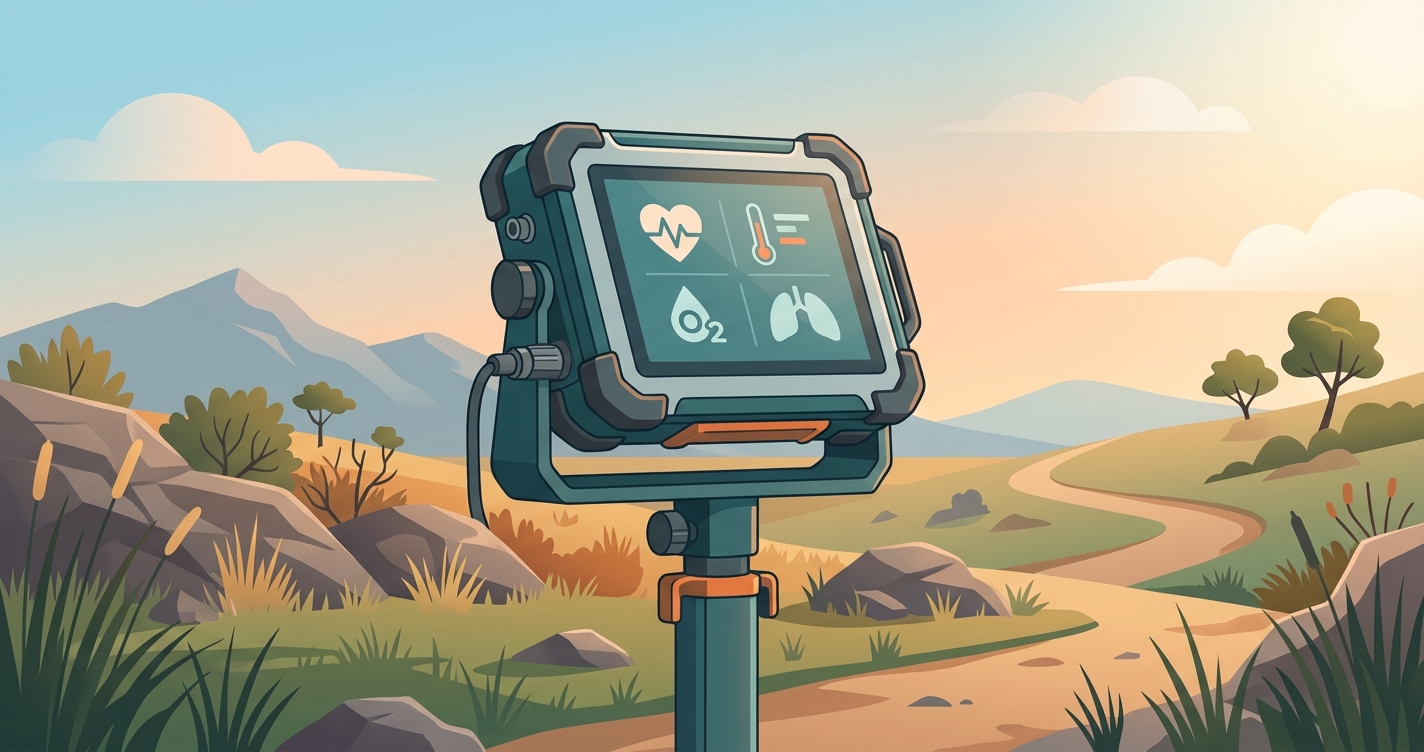
Ruggedized health monitoring field deployment has become a very practical design problem for medical device teams that want contactless screening or embedded vitals capture to work outside a clean, climate-controlled clinic. In the lab, almost any prototype can look stable for a few minutes. In the field, devices deal with dust, rain, glare, heat, power drops, transport vibration, and users who are standing wherever they can find shade. That gap between demo conditions and operating conditions is where most deployment risk lives.
"The smallest mean absolute R-R interval error was obtained under front lighting above 500 lux, and frame rates above 30 fps were required for sufficiently accurate measurements." — Tatsuya Kobayashi and colleagues, Sensors, 2021
Ruggedized health monitoring field deployment starts with environment, not algorithms
Medical device buyers in this niche are usually not asking whether camera-based vitals can run on embedded hardware. They are asking whether the whole system will still work after six months in a mobile clinic, outdoor checkpoint, pharmacy parking lot, or temporary screening tent. That is a different question.
The outdoor challenge is especially clear in remote photoplethysmography research. Hang Shao, Lei Luo, Jianjun Qian, Mengkai Yan, Shuo Chen, and Jian Yang wrote in their CVPR 2023 paper on rPPG in real-world and extreme lighting scenarios that outdoor measurements face complex time-varying interference from natural light and background conditions. Their point matters because ruggedization is not just about surviving impact. It is also about preserving signal quality when the environment will not cooperate.
For field teams, a rugged health monitoring system usually needs five things at once:
- an enclosure that tolerates dust, splash, and transport shock
- a camera and lighting path that can still capture usable facial signal outdoors
- stable local processing when connectivity drops
- battery and power design sized for real duty cycles, not lab sessions
- a workflow that degrades gracefully when the environment is worse than expected
| Design layer | What field deployments require | Why it matters |
|---|---|---|
| Enclosure | IP-rated housing, sealed connectors, impact resistance | Dust and rain failures usually happen before software failures |
| Capture system | Stable 30+ fps RGB camera, guided face position, controlled lighting | rPPG quality falls quickly in glare, motion, and uneven illumination |
| Compute | On-device inference and buffering | Remote sites cannot assume constant backhaul |
| Power | Battery backup, low-power idle modes, surge tolerance | Intermittent electricity is common in temporary or rural setups |
| Serviceability | Replaceable parts and remote diagnostics | Truck rolls are expensive and slow |
Enclosure, ingress protection, and transport stress
Rugged hardware decisions usually start with enclosure engineering. Intertek and other testing labs treat ingress protection as a core requirement for medical hardware because dust and liquid exposure change reliability long before a device looks visibly damaged. In practice, field systems rarely need the same protection level as underwater equipment, but they do need honest matching between the site and the rating.
That is also where MIL-STD-810H enters the conversation. The standard is not a magic certification for quality, but it gives manufacturers a structured way to test for shock, vibration, temperature swings, dust, and water exposure. For mobile screening carts, outdoor kiosks, and health stations that get loaded into vehicles, that matters more than glossy product language. A device that survives clinic use may still fail after repeated transport over rough roads.
I keep coming back to a simple rule here: if the deployment team expects cases, straps, vans, tents, and generators, the hardware team should stop pretending the product is a desktop appliance.
Practical ruggedization choices
- fan openings should be minimized or filtered in dusty environments
- connectors should be sealed or recessed to reduce water and cable damage
- displays need brightness high enough for daylight viewing, not just indoor lobbies
- mounting hardware should assume vibration and repeat movement
- exterior materials should tolerate aggressive cleaning and wide temperature swings
Outdoor vitals capture depends on lighting control more than marketing suggests
Field builders sometimes focus on processor choice and forget that camera-based health monitoring starts with optics and light. Kobayashi et al. showed in 2021 that front lighting above 500 lux and frame rates above 30 fps materially improved rPPG measurement conditions for telemedicine-style use. That is a hardware planning input, not just an academic footnote.
Shao and colleagues made the outdoor case even more directly in 2023 by showing how extreme lighting scenarios distort contactless measurement. If the deployment environment includes direct sun, moving shadows, reflective dust, or inconsistent shade structures, the enclosure needs its own lighting strategy. Otherwise the field team ends up blaming the model for what is really a capture problem.
| Outdoor condition | Common failure mode | Better engineering response |
|---|---|---|
| Direct sunlight | Facial saturation, unstable color signal | Hooded capture zone, controlled fill lighting |
| Moving shade | Time-varying signal distortion | Guided positioning and shorter capture windows |
| Wind and body motion | ROI drift and motion noise | Face stabilization, stance guidance, local retry logic |
| Dust or humidity | Lens contamination and sensor degradation | Protective lens covers and regular maintenance cycles |
| Night or low light | Underexposed frames and noisy signal | Dedicated front illumination and auto-exposure constraints |
This is one reason systems like Edge Computing for Real-Time Vitals: Hardware Requirements and What Is a Health Screening Station? Waiting Room Deployments are easier to build for controlled spaces than for outdoor field operations. Field deployments ask the same algorithms to perform inside a much sloppier physical envelope.
Power, battery life, and offline-first operation
The World Health Organization's compendium work on technologies for low-resource settings keeps pointing to the same operational truth: equipment reliability depends heavily on power stability, environmental fit, and maintainability, not just clinical intent. That applies just as much to embedded health monitoring as it does to point-of-care diagnostics.
For ruggedized health monitoring field deployment, power design usually breaks into three scenarios:
Fixed but unreliable power
These are sites with wall power that cuts out often. The device needs surge tolerance, short-term battery backup, and local data buffering. Without that, every outage becomes a failed session.
Mobile power
These are carts, transport cases, and portable stations. Battery chemistry, idle draw, and recharge logistics become part of the deployment plan. A system that technically runs for four hours may still be unusable if the field crew needs eight.
Remote or off-grid power
These sites need aggressive local processing, low-bandwidth sync, and careful sleep states. Continuous cloud dependency is a bad fit here. The smarter pattern is to keep capture, first-pass estimation, and audit logging on the device, then synchronize later.
- local buffering should survive both network loss and abrupt shutdowns
- sync queues need timestamps and retry logic
- battery indicators must be reliable enough for nontechnical staff
- maintenance teams need remote health telemetry before devices fail in the field
Where ruggedized health monitoring is being deployed
The buyer for getmedscan.com is usually a device builder, not a public health program manager, so the deployment pattern matters as much as the clinical use case.
Outdoor triage tents and emergency overflow sites
These systems need fast setup, daylight-readable displays, sealed enclosures, and resilient local compute. They also need capture zones that can create a little measurement discipline in a chaotic setting.
Mobile community screening vans
Vehicle vibration, irregular charging, and repeated packing and unpacking create more wear than a fixed clinic. Here, rugged mounts and connector design matter almost as much as sensor quality.
Industrial and occupational field stations
These devices often sit in mixed indoor-outdoor environments with dust, heat, and shift-based throughput. The engineering priority is sustained uptime with simple servicing.
Border, event, and temporary public health checkpoints
These sites create short interaction windows and unpredictable ambient conditions. A rugged enclosure helps, but the real win is guided workflow that can route users into a calmer secondary capture lane when needed.
Current Research and Evidence
The evidence base is not really saying that one rugged form factor wins. It says the environment drives the hardware brief.
Kobayashi et al. in Sensors (2021) found that front lighting above 500 lux and capture above 30 fps improved remote photoplethysmography measurement quality, especially for interval-level analysis. Shao, Luo, Qian, Yan, Chen, and Yang at CVPR 2023 focused on extreme lighting and outdoor conditions, showing why real-world interference remains central to field deployment performance. Rouast et al. in Artificial Intelligence in Medicine (2018) had already framed lighting, motion, and camera quality as first-order variables in rPPG system performance.
On the operational side, the World Health Organization's health technology guidance for low-resource settings reinforces that power reliability, environmental suitability, and supportability are part of the technology decision, not an afterthought. And standards frameworks such as MIL-STD-810H remain useful because they force teams to define what "rugged" means in the actual mission profile.
| Source | Year | Useful takeaway for field deployment |
|---|---|---|
| Rouast et al., Artificial Intelligence in Medicine | 2018 | Camera quality, lighting, and motion control remain fundamental system variables |
| Kobayashi et al., Sensors | 2021 | Front lighting above 500 lux and 30+ fps improve measurement conditions |
| Shao et al., CVPR | 2023 | Outdoor and extreme lighting introduce major time-varying interference for rPPG |
| WHO Compendium for Low-Resource Settings | 2024 | Device suitability depends on power, environment, and maintainability |
| MIL-STD-810H test framework | 2019 update | Rugged claims should be tied to actual temperature, shock, dust, and water testing |
The future of ruggedized health monitoring field deployment
I do not think the future winner in this category will be the most powerful box. It will be the system that best balances optics, enclosure design, local compute, serviceability, and power resilience. That sounds less glamorous than "AI at the edge," but it is closer to how real buying decisions get made.
Over the next few years, I expect rugged health monitoring systems to become more appliance-like: brighter guided capture zones, tighter camera-and-light integration, smarter battery telemetry, and better store-and-forward synchronization. In other words, less dependence on perfect sites and more tolerance for the kinds of places health teams actually work.
FAQ
What makes a health monitoring device ruggedized for field deployment?
Usually a mix of sealed enclosure design, shock and vibration tolerance, daylight-readable display hardware, controlled camera capture, local processing, and power resilience. Ruggedization is about surviving the site and still producing usable data.
Is an IP rating enough for outdoor medical deployments?
No. An IP rating helps with dust and water exposure, but field hardware also needs transport durability, thermal planning, connector protection, and a workflow designed for imperfect users and imperfect sites.
Why is lighting such a big issue in outdoor camera-based vitals?
Because rPPG depends on subtle color changes in the face. Studies by Kobayashi et al. and Shao et al. show that poor or unstable lighting can quickly damage signal quality, even when the compute stack is strong.
Should rugged health monitoring systems process data locally?
Usually yes for time-sensitive tasks. Local capture, signal extraction, and first-pass estimation make field systems more resilient when connectivity is weak or intermittent.
For device manufacturers building kiosks, carts, tablets, or embedded stations that must operate outside controlled indoor environments, the hard part is rarely the sensor alone. It is packaging the whole workflow into hardware that can keep going when the site gets hot, bright, dusty, and disconnected. Solutions like Circadify's clinical kiosk and embedded hardware builds are aimed at that deployment reality.