How to Build an Offline-Capable Health Screening Kiosk With Edge rPPG
Research analysis of the offline health screening kiosk edge rPPG stack, including local inference, store-and-forward workflows, device security, and deployment tradeoffs.
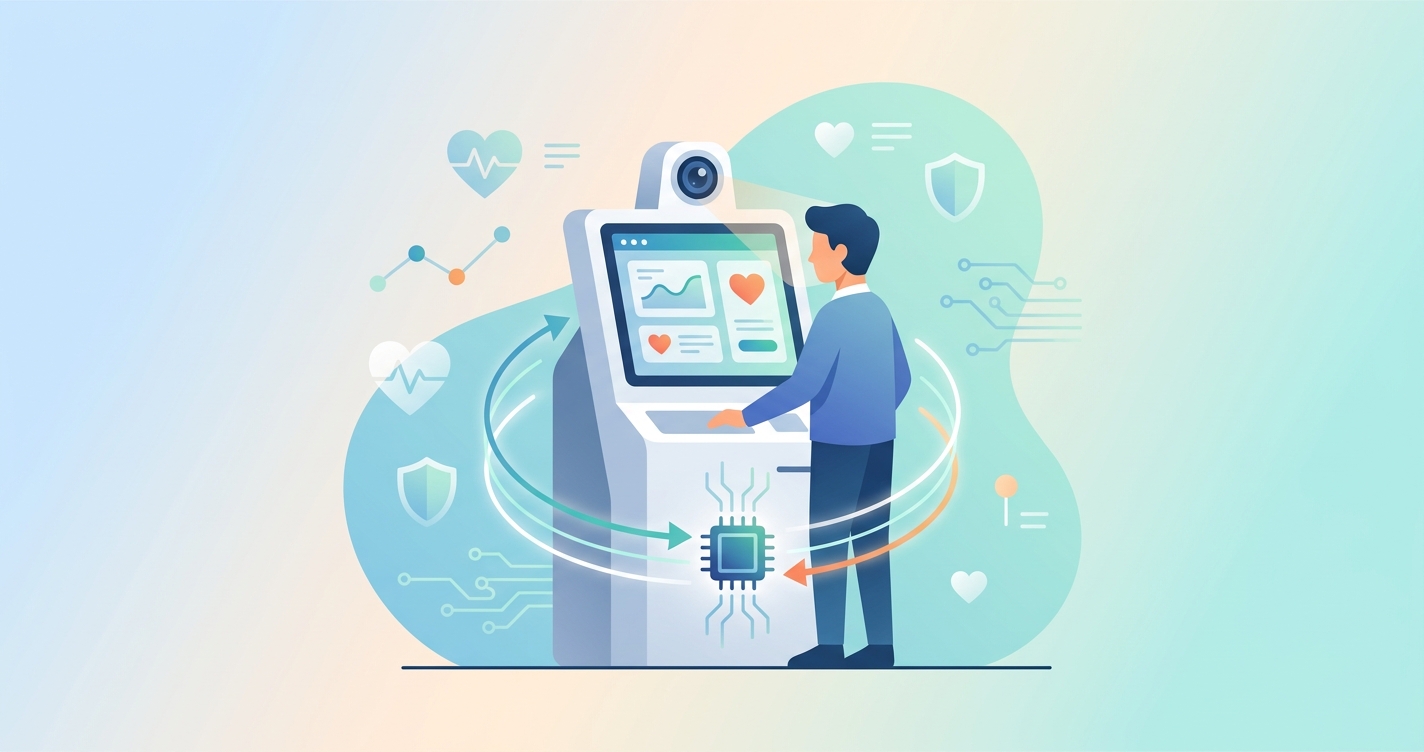
An offline health screening kiosk with edge rPPG solves a very specific deployment problem: plenty of screening environments need camera-based vitals, but they do not have dependable connectivity, generous bandwidth, or any appetite for sending raw face video into the cloud. That applies to rural clinics, temporary care sites, pharmacy outposts, mobile programs, and even large facilities with stubborn dead zones. In those settings, the interesting question is not whether contactless screening looks impressive in a demo. It is whether the kiosk still works when the network does not.
"A systematic search across PubMed, IEEE Xplore, and Google Scholar identified 5,537 articles, with 36 meeting inclusion criteria." — Saksham Bhutani and colleagues, Communications Medicine, 2025
Offline health screening kiosk edge rPPG architecture
The basic sensing idea is well established. Ming-Zher Poh, Daniel McDuff, and Rosalind Picard showed in Optics Express in 2010 that facial video and blind source separation could support non-contact pulse measurement. More recent reviews have pushed that work into practical health monitoring. In 2024, Robert van Geest, Jeroen van der Laar, and Ronald Janssen wrote in Frontiers in Digital Health that rPPG has strong evidence for measuring heart rate, respiratory rate, heart rate variability, blood pressure, and oxygen saturation under the right conditions.
The harder part is system design. A kiosk that depends on cloud inference is exposed to latency, bandwidth spikes, and privacy headaches. An offline-first kiosk moves the critical path onto the device itself:
- camera capture stays local
- face tracking and signal extraction run on the edge processor
- only derived outputs and audit events are queued for transmission
- store-and-forward sync handles delayed upload when a connection returns
- local rules decide whether the user passes, retries, or needs staff review
That architecture is less glamorous than a cloud dashboard, but I think it is closer to how real screening hardware has to behave.
| Architecture choice | What runs locally | What can wait for connectivity | Main tradeoff |
|---|---|---|---|
| Cloud-heavy kiosk | Capture only | Inference, storage, reporting | Simple device logic but fragile in poor networks |
| Edge-first kiosk | Inference, session logic, temporary storage | Fleet analytics, EHR sync, audit export | More capable hardware, better resilience |
| Fully offline kiosk | All measurement and decision logic | Manual export or delayed batch sync | Strong autonomy, weaker real-time integration |
| Hybrid store-and-forward kiosk | Measurement, triage, encryption, queueing | Clinical review and system-of-record updates | Best fit for intermittent-connectivity sites |
Why offline capability matters more than teams expect
Connectivity problems do not just slow a kiosk down. They change the workflow. If enrollment stalls, if a capture session times out while the device waits on a server, or if staff have to restart measurements because the WAN dropped, the kiosk stops feeling like infrastructure and starts feeling like a science project.
Bhutani and colleagues' 2025 systematic review of health kiosks makes this pretty plain. The field is growing, but standardization, performance testing, and user-experience evaluation still lag behind deployment ambition. Their review found blood pressure in 34% of studies and cardiovascular detection as the main motivation in 56% of them. The market clearly wants screening hardware. The evidence base is just telling builders to take operational details seriously.
That is why offline capability is not a niche feature. It is part of the safety margin.
The edge processor is doing more than inference
When people talk about edge rPPG, they usually mean local signal processing. Fair enough. But the processor in an offline kiosk is also handling session timing, image quality checks, retry logic, encryption, device health, and whatever limited rules engine tells the station what to do next.
A practical offline kiosk usually needs to answer these questions on-device:
- Is the face framed well enough for capture?
- Is motion low enough to trust the signal?
- Should the user retry, continue, or be escalated?
- Can the result be cached safely until sync is available?
- How long can the device store records before purge rules apply?
That is why posts like Edge Computing for Real-Time Vitals: Hardware Requirements and Embedded Vitals: Power, Bandwidth, and Hardware Requirements matter. Offline-first design is not just a software setting. It changes the hardware envelope.
What edge rPPG changes in kiosk design
Van Geest and colleagues' 2024 review is useful here because it separates the promise of rPPG from the conditions required to make it work. Camera-based vital sign capture is contactless and flexible, but it still cares about lighting, subject motion, camera quality, and signal processing. An offline kiosk cannot outsource those problems. It has to control them at the enclosure level.
That pushes the design toward a narrower but more dependable operating window:
- fixed face-to-camera distance
- stable frontal lighting
- predictable seating or standing position
- enough compute headroom for local processing
- thermal design that supports repeated sessions without throttling
I keep coming back to this point because it gets lost in product slides. Edge rPPG does not remove engineering constraints. It forces them into the open.
| Design layer | Offline-first requirement | Why it matters for edge rPPG |
|---|---|---|
| Camera subsystem | Stable frame timing and image quality | Signal extraction falls apart when capture is noisy |
| Lighting | Controlled and repeatable illumination | Reduces variability across sessions |
| Compute | CPU, GPU, or NPU headroom for local inference | Avoids cloud dependency during measurement |
| Secure storage | Encrypted queue for unsent sessions | Preserves data when links fail |
| Sync engine | Store-and-forward with conflict handling | Lets the kiosk recover gracefully after outages |
| Device management | Local logs and deferred telemetry | Keeps service teams from flying blind offline |
Store-and-forward is the missing piece
The Public Health Institute's Center for Connected Health Policy describes store-and-forward telemedicine as an asynchronous model where patient data is collected, transmitted securely, and reviewed later without requiring everyone to be online at the same time. That model fits an offline health screening kiosk almost perfectly.
A rural site does not always need a live round trip to a clinician or cloud platform. It needs the kiosk to complete the screening session, protect the data, and hand off the right packet when a network becomes available again. In practice, that means:
- local encryption before storage
- session identifiers that survive reconnects
- upload queues with retry logic
- clear separation between raw video, temporary processing buffers, and retained outputs
- audit logs that show what was captured, transmitted, and deleted
This is one of those spots where architecture decisions quietly become policy decisions. If the kiosk stores too much, the privacy burden grows. If it stores too little, the workflow breaks during outages. The sweet spot is usually derived measurements plus narrow audit metadata, with raw imagery discarded unless a use case genuinely requires retention.
Industry applications for offline-capable screening kiosks
Rural and satellite clinics
Small clinics often have enough connectivity for occasional record sync, but not enough to trust a cloud-dependent capture workflow. An edge kiosk gives them a predictable local session and a delayed upload path.
Temporary screening sites and mobile deployments
Pop-up programs, public health campaigns, and disaster-response setups are exactly the kind of environments where network assumptions age badly. Offline operation matters when the site itself is temporary.
Pharmacy and retail screening stations
Retail sites value uptime and short sessions. A kiosk that fails open every time the connection hiccups is expensive to support. Edge processing reduces that fragility.
Enterprise campuses and large facilities
Oddly enough, some large buildings have the same problem as remote clinics. Coverage is patchy, VLAN rules are messy, and integrations are slow to approve. Local processing gives the deployment team more control.
Current research and evidence
The evidence for camera-based measurement starts with foundational work from Poh, McDuff, and Picard at MIT, whose 2010 Optics Express paper showed automated pulse measurement from ordinary facial video. That paper mattered because it moved rPPG away from one-off lab demonstrations and toward an automated pipeline.
The 2024 review by van Geest, van der Laar, and Janssen broadened the discussion from pulse alone to health assessment more generally. Their review points to solid support for core physiological measures while also being honest about the deployment variables that still shape performance.
For kiosk design, the 2025 Communications Medicine review by Bhutani and colleagues is probably the most relevant operational paper in the stack. They reviewed kiosk studies from 2013 through 2023, found 36 papers that met inclusion criteria out of 5,537 screened, and pointed to missing standardization, weak performance testing, and limited user-experience evaluation. That does not read like a warning against kiosks. It reads like a reminder that the hardware market is moving faster than the evidence culture around it.
On the workflow side, the Center for Connected Health Policy's discussion of store-and-forward telemedicine helps explain why asynchronous sync is such a good fit for offline kiosks. The model removes the requirement for constant live connectivity and gives programs a cleaner way to support intermittent networks without abandoning structured care workflows.
The future of offline health screening kiosk edge rPPG
I doubt the next generation of kiosk deployments will be fully offline forever. That is not really the point. The more likely direction is offline-tolerant infrastructure: devices that can measure, decide, encrypt, and queue locally, then sync cleanly when the rest of the system catches up.
A few design trends look especially likely:
- more on-device inference so raw video stays local
- better queueing and replay logic for intermittent networks
- tighter separation between temporary processing data and retained clinical outputs
- more purpose-built hardware for kiosks instead of generic tablets in enclosures
- stronger demand for auditability in environments that cannot rely on real-time cloud logs
The real shift is cultural as much as technical. Buyers are getting less interested in whether a kiosk can perform a polished demo under perfect Wi-Fi. They want to know what happens on a bad Tuesday when the network is down and the waiting room is still full.
Frequently Asked Questions
What is an offline health screening kiosk with edge rPPG?
It is a kiosk that captures camera-based vital signs locally, processes the session on-device, and continues operating even when the internet connection is unavailable or unreliable.
Why use edge rPPG instead of cloud processing?
Edge processing reduces latency, limits dependence on network quality, and makes it easier to avoid transmitting raw facial video outside the device during the measurement session.
Does offline operation mean no integration at all?
No. Most practical systems use delayed synchronization. They measure and triage locally, then upload results, logs, or structured records later through a store-and-forward workflow.
What are the biggest engineering challenges?
Lighting control, camera quality, thermal stability, secure local storage, retry logic, and clean sync behavior after connectivity returns all matter. Offline capability is a system problem, not a single feature.
For device makers and kiosk teams, the interesting opportunity is not a cloud demo that works in a lab. It is a field-ready screening station that keeps measuring, keeps logging, and keeps its data model intact when connectivity gets ugly. That is the sort of deployment problem Circadify's custom clinical kiosk work is built to address.