What if your car's screen could warn you about fatigue before a long trip?
A look at the potential for vehicle infotainment systems to detect driver fatigue using embedded sensors, and what it means for automotive and IoT companies.
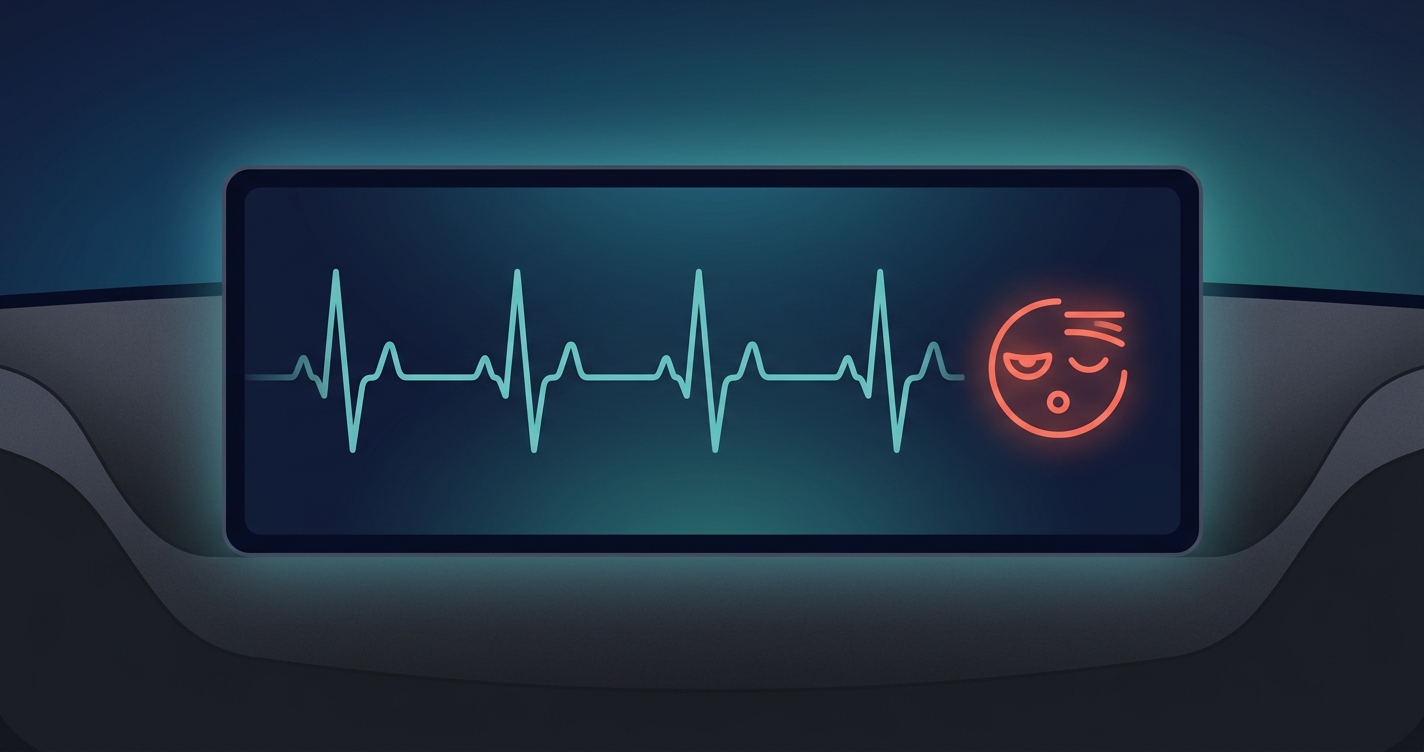
The automotive industry is undergoing its most significant transformation in a century. Performance is no longer measured solely by horsepower and handling, but by the intelligence of the in-cabin experience, the seamlessness of its connectivity, and the proactiveness of its safety systems. The dashboard screen, once a simple display for radio frequencies and maps, is now the central command for a sophisticated network of sensors. For engineers and product leaders at IoT and medical device companies, this evolution presents a new frontier: the potential for the vehicle itself to become a health and wellness platform, starting with one of the most persistent problems in road safety, driver fatigue.
"The National Highway Traffic Safety Administration (NHTSA) estimates that fatigue-related crashes resulting in injury or death cost society $109 billion annually, a figure many researchers believe is significantly underreported due to the difficulty of post-crash verification."
The technical challenge of in-car health monitoring
The core problem of in-car health monitoring is not the measurement of physiological signals, but their reliable measurement in a difficult environment. A vehicle is a constantly moving, vibrating space with unpredictable lighting conditions, driver positions, and cabin temperatures. Unlike a clinical setting, a car has no trained technician to ensure sensors are placed correctly. The system must simply work, invisibly and continuously, for any driver, in any condition. This requires a shift from contact-based measurement (like clinical cuffs and probes) to ambient, contactless sensing integrated directly into the cabin hardware. The primary candidate for this integration is the driver-facing camera, already becoming a standard component for attention and identity-verification systems. By using this existing hardware, device makers can use technologies like remote photoplethysmography (rPPG) to extract vital signs like heart rate, heart rate variability, and respiration rate from subtle changes in reflected light on the driver's skin.
| Modality | Core Technology | Advantages | Disadvantages |
|---|---|---|---|
| Camera (rPPG) | Optical sensors analyzing skin tone changes | Contactless; uses existing camera hardware; can be combined with computer vision for behavioral analysis (e.g., head position). | Sensitive to lighting changes and motion; requires significant processing power (often on the edge). |
| Steering Wheel | Embedded ECG/GSR sensors | High-quality cardiac signal (ECG); direct skin contact provides strong signal-to-noise ratio. | Requires hands to be in a specific position; sensor materials can wear; dependent on physical contact. |
| In-Seat Sensors | Ballistocardiography (BCG) or capacitive ECG | Unobtrusive and invisible to the user; can be integrated into the seat structure. | Signal can be noisy due to body movement and road vibration; capacitive ECG can be affected by clothing thickness. |
| Radar | Millimeter-wave (mmWave) radar | Contactless; can penetrate clothing; insensitive to lighting conditions; can measure respiration and heart rate. | Higher component cost; may struggle to isolate the driver's signals from passengers; less mature for vitals than other methods. |
Key physiological markers are the foundation of any robust fatigue detection system. While behavioral signs are useful, they often indicate that fatigue has already set in. Physiological data provides a look ahead.
- Heart Rate Variability (HRV): A decrease in HRV is strongly correlated with increased cognitive load and the onset of mental fatigue.
- Respiration Rate: Changes in breathing patterns, particularly slower and deeper breathing, can be an indicator of drowsiness.
- Blink Frequency and Duration: Increased blink duration (PERCLOS - Percentage of Eye Closure) is a classic, lagging indicator of sleepiness.
- Head Pose Estimation: Using the same camera as rPPG, the system can track head position and detect slumping or "head nodding" events.
Industry Applications
The integration of fatigue detection is not just a safety feature; it is a platform capability that enables new services and business models for automotive manufacturers and their Tier 1 suppliers.
Commercial fleet management
For trucking and logistics companies, driver fatigue is a major operational risk and liability. Integrating in-car health monitoring allows for real-time risk assessment. A system could alert both the driver and the fleet manager when physiological signs of fatigue are detected, suggesting a mandatory rest break long before an incident occurs.
Advanced driver-assistance systems (adas)
Modern ADAS platforms can already perform actions like lane-keeping and emergency braking. When linked to a reliable fatigue detection system, the vehicle can take more proactive steps. For example, if physiological fatigue markers are high, the system could increase the follow distance to the car ahead or make the lane-keeping assist more assertive, providing a larger margin of safety.
Insurance and telematics
Usage-Based Insurance (UBI) models currently rely on metrics like speed, acceleration, and time of day. The next generation of telematics could incorporate driver state data. Anonymized, aggregated data on driver alertness could allow insurance providers to more accurately price risk and even offer discounts to drivers or fleets that consistently demonstrate safe behaviors, as verified by the vehicle's internal sensors.
Current research and evidence
The theoretical basis for camera-based vitals monitoring is well-established, but its application in the automotive space is an active area of research. Work by researchers like Bryan Reimer at the MIT AgeLab has been pivotal in understanding the interplay between driver cognitive load, automation, and vehicle interfaces. A 2021 study published in the journal Sensors demonstrated the feasibility of using a standard RGB camera to accurately measure heart rate variability in a driving simulator, noting that rPPG-derived HRV metrics correlated strongly with those from a traditional ECG. Similarly, research from the Fraunhofer Institute for Integrated Circuits has explored the use of radar for detecting driver and passenger vitals, demonstrating its robustness to lighting conditions. The consensus in the research community is that multi-modal systems, which fuse data from cameras (for rPPG and behavioral analysis) with other sensors like radar or in-seat BCG, will provide the most reliable and robust solutions for detecting driver impairment.
The future of in-car health monitoring
Looking ahead, the focus on driver fatigue will expand to a more holistic concept of in-cabin wellness and passenger monitoring. The same sensors used to detect a driver's drowsiness could also monitor a passenger's stress level or a baby's respiratory rate in a car seat in the back. The car is evolving into an "edge node" in a person's digital health ecosystem. For this to become a reality, the underlying sensor technology must be embeddable, power-efficient, and capable of processing sensitive health data locally on the device to ensure user privacy and security. The future of in-car health monitoring depends on the ability of embedded system developers to create a reliable bridge between the noisy, unpredictable environment of the car and the precision required for clinical-grade physiological measurement.
Frequently asked questions
Q: How is this different from existing systems that just watch a driver's eyes?
A: Current driver monitoring systems (DMS) primarily use computer vision to track eye closure and head position. These are behavioral indicators that detect drowsiness after it has already begun. The next generation of in-car health monitoring adds a physiological layer, measuring signals like heart rate variability (HRV) that can predict the onset of fatigue before obvious symptoms appear.
Q: Are these systems collecting and storing my personal health data?
A: This is a critical design consideration for system architects. The industry trend is towards edge computing, where raw sensor data (like video from a camera) is processed locally within the vehicle. The system extracts the necessary biomarkers (e.g., a high fatigue score) and then discards the raw data. This approach enhances privacy and security by minimizing the data that is stored or transmitted.
Q: What is the primary technology used for contactless fatigue detection?
A: The most common and rapidly advancing technology is camera-based remote photoplethysmography (rPPG). It is cost-effective because it can use the same camera hardware that is already being installed in cars for driver monitoring and facial recognition. This ability to serve multiple functions with a single sensor is a major advantage for automotive and IoT device manufacturers.
As the automotive industry shifts towards proactive safety systems driven by artificial intelligence, the demand for robust, embeddable sensors for in-car health monitoring is accelerating. For IoT platform providers and device manufacturers, the core challenge lies in integrating clinical-grade measurement into the highly constrained and variable environment of a vehicle. Circadify is at the forefront of this space, providing the core rPPG engine that powers next-generation embedded vitals monitoring. To learn more about the hardware and software requirements for integrating this capability into your own custom builds, see our hardware integration guide at circadify.com/custom-builds/clinical-kiosks.