
Your Next Car Will Be a Health-Monitoring Device in 2026
Explore the emerging trend of in-car health monitoring, where driver safety mandates and embedded rPPG cameras turn vehicles into contactless health endpoints.
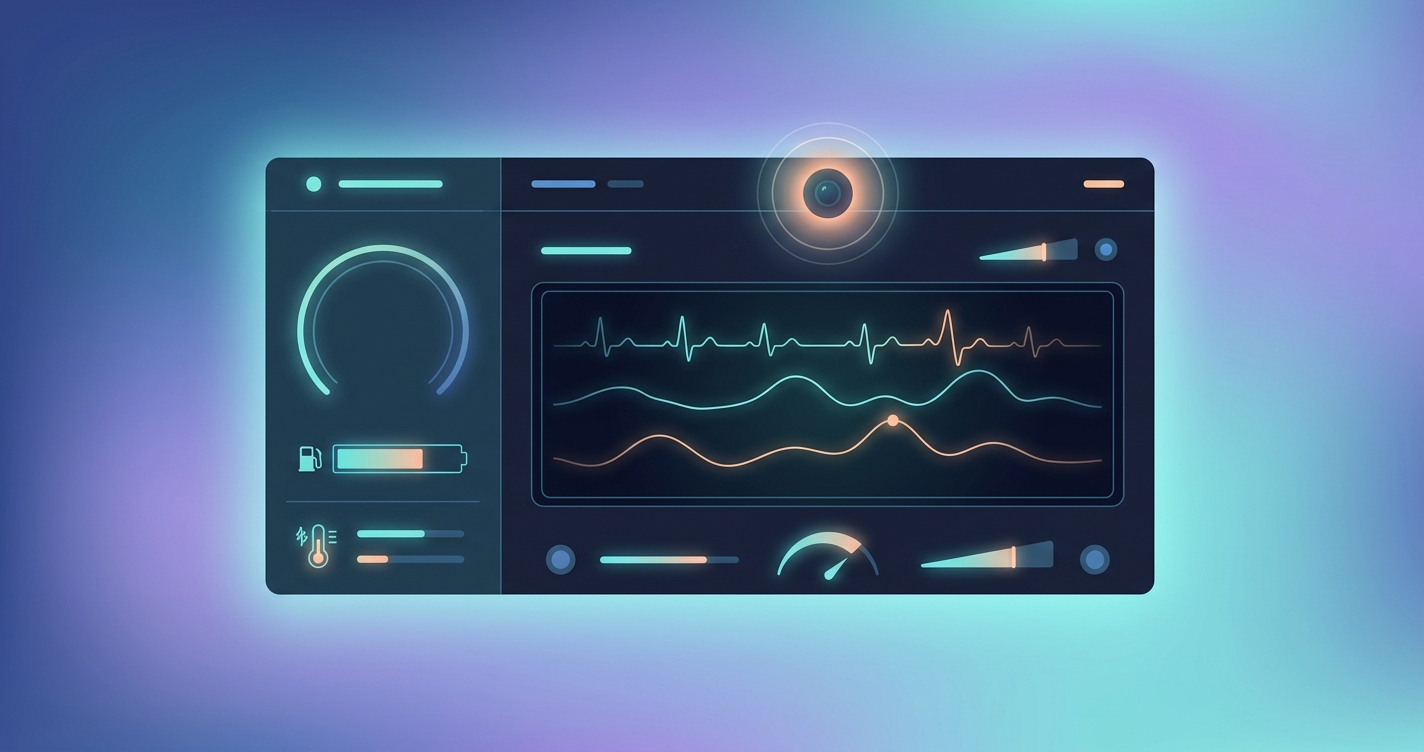
The interior of the modern vehicle is undergoing a quiet but fundamental transition. For decades, automotive engineering focused almost exclusively on external safety parameters by deploying radar, LiDAR, and exterior camera arrays to map the physical environment and avoid collisions. Today, shifting regulatory frameworks and advancements in embedded processing are forcing the industry to look inward at the driver. As cabin-facing cameras become mandatory equipment to meet strict new global safety standards, medical device manufacturers, IoT platform providers, and Tier 1 automotive suppliers are converging on a shared realization. The same optical sensor installed to track eye movement can function as a continuous physiological measurement tool. This convergence is establishing the foundation for in-car health monitoring, turning the driver's seat into a contactless screening endpoint without adding new hardware to the bill of materials.
"The global automotive active health monitoring system market was valued at approximately $3.5 billion in 2024 and is projected to reach $8.2 billion by 2033, driven by the integration of AI-powered biometric sensors and strict driver fatigue mandates." - DataHorizzon Research, 2024
The regulatory push for in-car health monitoring
The rapid deployment of cabin-facing cameras is not merely a feature enhancement; it is a strict regulatory requirement. In the European Union, Driver Drowsiness and Attention Warning (DDAW) systems are mandated for all newly registered vehicles . Simultaneously, safety assessment programs like Euro NCAP have integrated driver state monitoring into their scoring criteria, effectively making interior cameras a necessity for any vehicle manufacturer aiming for a five-star safety rating. National highway authorities in North America and Asia are closely monitoring these rollouts, hinting at a rapid global standardization of interior optical sensors.
When an automotive manufacturer is forced by law to install a high-fidelity image sensor into a vehicle's dashboard, procurement and engineering teams immediately look for ways to extract maximum utility from that sunk hardware cost. Health and wellness features provide a highly marketable return on investment. Once this optical hardware is deployed to monitor basic behavioral cues, such as head pose, gaze direction, and eyelid closure, the physical infrastructure is fully capable of capturing deeper physiological data.
Remote photoplethysmography (rPPG) enables these exact same lenses to detect micro-vascular color changes in human skin with every cardiac cycle. By processing these subtle visual signals locally on the vehicle's internal edge computing hardware, systems can track vital signs continuously. This removes the friction of requiring the driver to wear a dedicated smart watch or interact with a distinct medical device, seamlessly merging automotive safety with physiological screening.
Contactless rPPG vs. traditional automotive sensors
Historically, attempts to capture driver vital signs relied on physical contact. Engineers experimented with embedding electrocardiogram (ECG) nodes into the steering wheel or placing ballistocardiography sensors inside the seat fabric. While effective in controlled laboratory environments, contact-based sensors introduce mechanical complexity, rely on specific driver positioning, and increase manufacturing costs. The shift toward software-defined camera vitals eliminates these mechanical failure points entirely.
| Sensor Technology | Driver Friction | Integration Cost | Primary Limitation |
|---|---|---|---|
| Steering Wheel ECG | High (requires continuous, specific grip) | Moderate (specialized conductive materials) | Fails if the driver uses one hand or changes grip |
| Wearable Integration | High (requires pairing and charging) | Low (BYOD approach relying on user hardware) | Total reliance on consumer device battery and compliance |
| Seat-Based Ballistocardiography | Zero (passive contact through clothing) | High (embedded mechanical seat sensors) | Highly susceptible to vibration noise from road surfaces |
| Contactless Camera (rPPG) | Zero (passive ambient optical monitoring) | Low (utilizes mandated safety cameras) | Requires advanced computing algorithms for motion artifacts |
Physiological metrics captured via camera
Using embedded rPPG, automotive IoT endpoints can extract multiple physiological metrics simultaneously, providing a comprehensive assessment of the driver's physical state:
- Continuous heart rate: Establishes a baseline of cardiovascular activity to monitor general driver alertness and detect sudden anomalies.
- Heart rate variability (HRV): Serves as a highly accurate proxy for cognitive stress, mental workload, and the early onset of physiological fatigue.
- Respiration rate: Detects shallow or irregular breathing patterns that are strongly indicative of drowsiness or impending sleep.
- Micro-movements and cardiac pulse transit time: Correlates with early onset microsleeps that behavioral eye-tracking might miss in complex lighting.
Industry applications for automotive health sensors
Commercial fleet iot and telematics
For commercial logistics and long-haul transportation, driver fatigue is a critical liability and a major contributor to catastrophic accidents. Fleet operators currently use IoT telematics platforms to track vehicle speed, hard braking, and location. However, traditional vehicle telematics cannot predict when a driver is experiencing acute physiological exhaustion.
Integrating contactless vitals into existing dashcam hardware provides fleet managers with objective, real-time data on the actual state of the human operating the machinery. By monitoring heart rate variability and respiration, an IoT platform can trigger automated interventions, such as routing the driver to a rest stop or reducing maximum vehicle speed, long before a collision occurs.
Autonomous vehicle handover
As the automotive industry progresses toward Level 3 and Level 4 autonomous driving, the vehicle handles the majority of the driving tasks, but the human must remain ready to take control in complex scenarios. The transition of control from the machine back to the human, known as the handover problem, is highly dangerous if the human is asleep, highly stressed, or medically incapacitated. In-car health monitoring provides the autonomous system with a verification mechanism. Before disengaging the autopilot, the vehicle can verify that the driver's cardiovascular and respiratory metrics indicate full wakefulness and cognitive readiness.
Tier 1 suppliers and clinical kiosk parallels
Tier 1 suppliers are rapidly transitioning from manufacturing isolated physical components to providing complete, software-defined cabin experiences. By embedding rPPG algorithms directly onto system-on-chip architectures, suppliers offer OEMs a turnkey driver monitoring system that requires no additional sensor bill of materials.
The hardware constraints of an automotive cabin closely mirror the engineering challenges of self-service clinical kiosks. Both environments require reliable physiological measurement under highly variable lighting conditions. Both demand strict data privacy with edge-processing architecture. And both must operate autonomously with zero patient or driver training. Medical device manufacturers and IoT engineers are increasingly utilizing automotive-grade algorithms to harden their own contactless screening products for deployment in uncontrolled public environments.
Current research and evidence
The validation of camera-based vitals in moving vehicles has accelerated, shifting from isolated lab experiments to robust, real-world trials. The primary engineering hurdle in automotive rPPG has always been extracting a clean pulsatile signal while mitigating extreme motion artifacts caused by road vibration, rapidly shifting illumination from streetlights, and partial facial occlusion from sunglasses.
A comprehensive 2024 systematic review by researcher Soha G. Ahmed and colleagues examined AI innovations in rPPG systems specifically built for driver monitoring. The research concluded that spatial-temporal networks and convolutional neural networks have successfully bridged the gap between stationary clinical settings and dynamic automotive environments. By training algorithms to separate the true blood volume pulse from environmental noise, researchers have achieved robust accuracy even under challenging conditions.
Further emphasizing this shift toward robust environmental testing, a 2024 study led by Jiyao Wang introduced "PhysDrive", a multimodal remote physiological measurement dataset designed exclusively for in-vehicle monitoring. Traditional rPPG datasets feature subjects sitting perfectly still in brightly lit rooms, which is useless for automotive engineering. Wang's team recognized that deep learning models trained on stable video feeds fail completely when introduced to the harsh realities of a moving cabin. By open-sourcing multimodal datasets that include near-infrared video, thermal imaging, and synchronized ground-truth ECG readings captured during actual driving scenarios, researchers are giving IoT platform providers the exact tools needed to train robust algorithms. These research initiatives demonstrate that continuous, contactless physiological measurement in vehicles is no longer a theoretical concept, but an actively maturing engineering discipline.
The future of in-car health monitoring
By 2026, the artificial distinction between an automotive driver monitoring system and a remote patient monitoring endpoint will narrow significantly. As highly efficient edge AI processors, capable of executing complex neural networks at the device level, become standard in vehicle architectures, the reliance on cloud computing for physiological analysis will disappear. This on-device processing resolves the most critical barrier to adoption: data privacy. Because the camera feed is processed in real-time within the vehicle and instantly discarded, no identifiable video data ever leaves the local hardware.
Future iterations of these systems will move far beyond basic fatigue detection. By establishing longitudinal baselines of a driver's physiological state over months of commuting, the vehicle could detect acute medical events, such as cardiac anomalies, sudden drops in blood oxygenation, or impending stroke symptoms. Upon detecting a critical event, the vehicle's autonomous systems could securely pull the car to the shoulder, activate hazard lights, and autonomously initiate communication with emergency dispatch services. This progression will firmly cement the vehicle cabin as a primary, life-saving node within the broader health IoT ecosystem.
Frequently asked questions
What exactly is in-car health monitoring?
In-car health monitoring refers to the integration of biometric sensors, most commonly software-enabled cabin cameras, to continuously track a driver's physiological state. By measuring metrics like heart rate, respiration, and stress levels, the vehicle can detect fatigue, cognitive overload, or sudden medical emergencies to improve overall road safety.
How does a standard car camera measure a heartbeat?
Automotive cameras use a technology called remote photoplethysmography (rPPG) to detect microscopic changes in skin color caused by blood flow. With every cardiac cycle, the absorption of ambient or infrared light changes across the face. Specialized algorithms isolate these subtle shifts to calculate heart rate and respiration without requiring any physical contact.
Do these health systems require an active internet connection?
No. Next-generation automotive health sensors are built on edge computing principles. The physiological data is processed locally on the vehicle's internal hardware. This localized processing ensures zero latency for safety-critical alerts and eliminates the need to transmit sensitive biometric video to external cloud servers.
Will automotive health monitoring replace wearable medical devices?
In-car systems are specifically designed for continuous screening, fatigue detection, and immediate safety interventions, not for comprehensive clinical diagnosis. While they share underlying rPPG technology with clinical kiosks and medical wearables, their primary function is to operate passively as an early warning system during transit.
For hardware engineering teams and product managers, integrating physiological measurement into complex environments requires highly robust, edge-optimized software. Circadify provides an embedded rPPG engine built to operate seamlessly on existing camera hardware, whether deployed in dynamic automotive cabins or stationary self-service healthcare stations. To learn how to deploy contactless vitals on your proprietary hardware and meet the demands of the next generation of IoT devices, read our Hardware integration guide.