How to Integrate rPPG Into a Medical Device Under IEC 62304
A practical analysis of rPPG medical device integration under IEC 62304, including software safety classes, architecture, verification, cybersecurity, and submission planning.
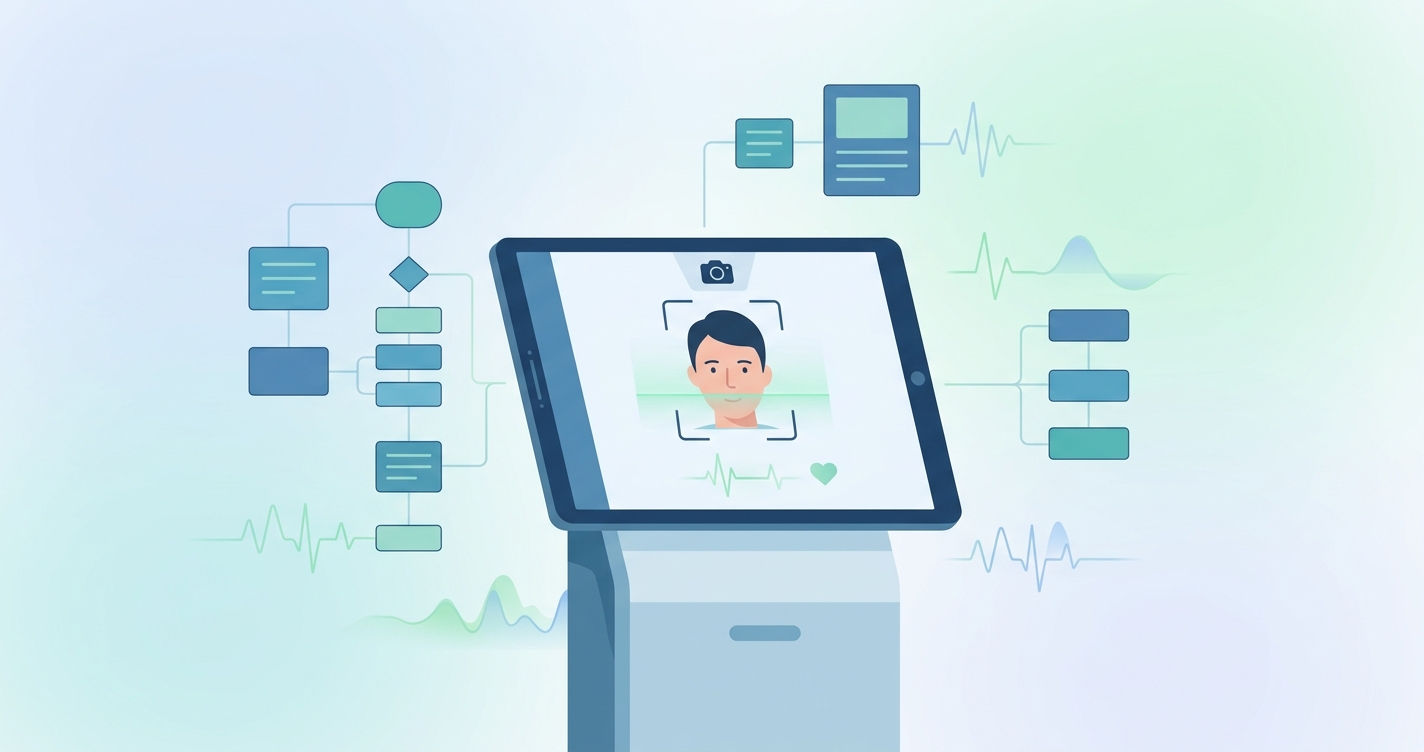
RPPG medical device integration under IEC 62304 looks straightforward on a slide and much messier in an actual development program. Camera-based vital-sign capture is appealing because it fits kiosks, tablets, bedside terminals, and other embedded devices without adding cuffs, clips, or disposable sensors. The hard part starts when that signal chain has to live inside a regulated product. Suddenly the conversation shifts from model performance alone to software safety class, risk controls, traceability, cybersecurity evidence, and what the regulator will expect to see in the file.
"IEC 62304 is the international standard for medical device software lifecycle processes, focused on risk reduction and patient safety." — U.S. FDA recognized consensus standard summary and 2023 device software guidance
RPPG medical device integration under IEC 62304 starts with system boundaries
I keep coming back to one question here: what exactly is the software item? That sounds basic, but it drives almost everything that follows. An rPPG-enabled device usually includes camera capture, illumination control, signal-quality checks, pulse extraction, user guidance, UI logic, storage, connectivity, and handoff into a larger workflow. If teams treat "the algorithm" as the only regulated element, they usually end up with a weak architecture and a painful verification plan.
IEC 62304 is built around lifecycle control for medical device software. That means the integration work starts by defining software system boundaries, software items, and interfaces early enough that hazards can be traced to real components rather than vague platform diagrams.
For embedded rPPG devices, the software stack often breaks down into these layers:
- camera and hardware abstraction
- image preprocessing and illumination handling
- signal extraction and quality assessment
- vital-sign estimation logic
- UI, prompts, and measurement workflow control
- device communications, storage, logging, and update functions
That decomposition matters because failure modes are spread across the stack. A pulse estimate can be wrong because of signal-processing logic, but it can also be wrong because exposure control drifted, the user was positioned badly, or the workflow accepted a low-quality capture it should have rejected.
| Software area | Typical rPPG role | Why it matters under IEC 62304 |
|---|---|---|
| Camera and sensor control | Capture stable face video and timing data | Hardware-software faults can corrupt the entire measurement chain |
| Preprocessing and quality gating | Normalize frames, detect motion, reject poor captures | Risk controls often live here, not only in the model |
| Vital-sign estimation | Convert signal into pulse or other outputs | Core analytical function that needs strong traceability |
| UI and workflow logic | Guide positioning and measurement completion | Use error can become a software risk issue fast |
| Data and connectivity | Store outputs, export results, receive updates | Cybersecurity and integrity requirements land here |
Safety classification shapes the whole development plan
IEC 62304 classifies software as Class A, B, or C based on the harm that could follow a software failure. Class A maps to no injury, Class B to non-serious injury, and Class C to death or serious injury. In practice, rPPG teams do not decide this by asking whether the algorithm is sophisticated. They decide it by asking what happens if the device is wrong and the wrong result reaches a clinical or operational workflow.
That is why integration context matters more than the camera model. The same rPPG engine can sit in very different products:
- a wellness-oriented screening station
- a triage-support kiosk
- a chronic-care monitoring terminal
- a clinical workflow device feeding decisions or escalation paths
A vendor may hope to classify the software conservatively, but the intended use, risk controls, and downstream actions will do the real work. The FDA's 2023 software submission guidance uses a similar risk lens when it separates documentation into Basic and Enhanced levels. If failure of a device software function could lead to death or serious injury before risk controls are applied, the agency expects Enhanced documentation.
Architecture is where most rPPG programs quietly win or lose
Recent reviews make the technical problem pretty clear. Linas Saikevičius, Vidas Raudonis, Gintaras Dervinis, and Virginijus Baranauskas wrote in their 2024 systematic review that non-contact vision-based monitoring can estimate pulse, respiratory rate, oxygen saturation, and blood pressure remotely, but performance still depends heavily on data quality, preprocessing, and training data. That is not just an algorithm note. It is an architectural note.
If the product team already knows motion, lighting variance, and subject variability are major error sources, then the architecture should reflect that reality.
A more defensible embedded design usually includes:
- explicit signal-quality thresholds before estimation proceeds
- controlled capture duration and user-positioning checks
- separation between raw acquisition, derived features, and displayed outputs
- local logging for anomalous sessions and verification replay
- a clear fallback state when capture quality is insufficient
| Integration pattern | Advantage | Regulatory tradeoff |
|---|---|---|
| Monolithic app with rPPG embedded everywhere | Fast prototype path | Harder traceability, testing, and anomaly isolation |
| Modular pipeline with separate quality gate | Cleaner risk control mapping | More interface definitions to verify |
| On-device inference with local decision logic | Better latency and privacy control | Higher embedded verification burden |
| Cloud-dependent measurement workflow | Easier central updates | Added cybersecurity, latency, and availability concerns |
| Hybrid edge-plus-cloud design | Flexible fleet management | More complex configuration control |
For most kiosk and clinical hardware teams, a modular edge-first pipeline is the safer bet. It gives the quality system something concrete to verify.
Industry applications for embedded rPPG device programs
Clinical kiosks and waiting-room devices
This is one of the cleanest fits because distance, framing, and lighting can be partly controlled. A kiosk enclosure can standardize capture conditions better than a handheld consumer environment. That is why many manufacturers start with guided workflows similar to the ones discussed in our analysis of embedded rPPG clinical kiosks.
Tablets and fixed smart displays
Tablets are attractive because the hardware is familiar and cheap, but they also create variability in camera placement, processor load, and thermal behavior. Teams need a verification plan that covers real deployment configurations rather than one ideal lab setup.
Connected IoT and edge health endpoints
Networked endpoints can fit broader care workflows, but they also invite configuration drift. If the device depends on remote model updates, remote rules, or cloud-side processing, software maintenance and problem-resolution procedures under IEC 62304 get more important, not less. We covered the systems angle in rPPG IoT integration architecture.
Current research and evidence
The research base is encouraging, but it does not let anyone skip engineering discipline. In a 2024 clinical validation study of contactless pulse-rate monitoring in cardiovascular disease patients, researchers analyzed 817 samples from 47 participants and reported strong agreement between rPPG-derived pulse rate and ECG, with a mean absolute error of 1.061 bpm and Pearson correlation of 0.962. That kind of evidence helps explain why device makers keep pursuing camera-based monitoring.
It also has to be read carefully. The same paper calls for more work on irregular rhythms, additional vital signs, and broader cohorts. In other words, good validation data does not erase the need for intended-use discipline.
The broader review literature says something similar. Saikevičius and colleagues point to progress across pulse, respiration, oxygen saturation, and blood pressure estimation, but they also flag limited annotated training data and the continuing importance of robust preprocessing. That is exactly the sort of evidence a development team should turn into requirements, test plans, and risk controls instead of marketing claims.
Outside the algorithm itself, the FDA's 2023 final guidance on software submissions changed another important part of the picture. The agency moved away from the old major-moderate-minor software framework and now expects Basic or Enhanced documentation based on risk. For rPPG programs, that pushes teams to define hazardous situations early and tie software evidence to them directly.
Cybersecurity and maintenance are now part of the integration story
A lot of teams still talk about cybersecurity as if it belongs to IT after launch. That is not where the FDA is anymore. Its 2023 final cybersecurity guidance treats cybersecurity as part of device safety and effectiveness across the total product lifecycle. For cyber devices, the agency also expects a software bill of materials, security architecture information, threat modeling, vulnerability analysis, and testing evidence.
For embedded rPPG products, that affects more than the network stack. It affects:
- third-party vision libraries
- operating-system dependencies
- model packaging and update mechanisms
- remote diagnostics tools
- cloud APIs if measurement or review data leaves the device
That is one reason IEC 62304 integration work cannot stop at release. Maintenance planning, anomaly handling, and controlled updates are part of the regulated product, not a side project for later.
The future of rPPG medical device integration under IEC 62304
The field is moving toward more mature combinations of vision models, guided workflow design, and embedded compute. I do not think the winners will be the teams with the most dramatic demo. They will be the ones that can connect signal science to a regulated software file without hand-waving.
That likely means a few things over the next several years:
- more modular software architectures for camera-based sensing
- more emphasis on signal-quality management as a formal risk control
- stronger linkage between algorithm validation and device-level verification
- tighter cybersecurity expectations for connected endpoints
- broader use of adjacent standards and guidance alongside IEC 62304, including ISO 14971 and FDA software submission guidance
IEC 62304 does not tell manufacturers whether rPPG is clinically useful for a given claim. It does force them to build the software like a medical device program instead of a prototype.
FAQ
Is IEC 62304 enough by itself for an rPPG medical device?
No. IEC 62304 is the software lifecycle standard, not the whole regulatory picture. Teams usually need risk-management work under ISO 14971, quality-system controls, usability thinking, cybersecurity documentation, and device-level validation evidence as well.
Does rPPG software automatically become high-risk under IEC 62304?
No. The safety class depends on intended use and the harm that could follow a failure. The same core software can land in a different classification depending on where it sits in the workflow and what decisions depend on it.
What is the biggest integration mistake for embedded rPPG devices?
Treating the algorithm as a standalone component and ignoring the rest of the measurement workflow. In real devices, capture quality, user guidance, timing, storage, and update control all affect safety and performance.
Why does FDA's 2023 software guidance matter for rPPG teams?
Because it changed the documentation framework to Basic and Enhanced levels based on risk. That pushes manufacturers to define hazardous situations earlier and align software evidence with real clinical or operational consequences.
For manufacturers building kiosks, tablets, and connected clinical hardware, the practical opportunity is to integrate camera-based vitals capture into a software architecture that can survive design review, verification, and post-market change control. Solutions like Circadify's custom clinical kiosk builds are aimed at that embedded integration problem.