How Automated Vitals Save 5 Mins Per Patient Check-In
Quantifying the operational ROI and automated patient intake benefits of replacing manual vitals triage with camera-based clinical kiosks.
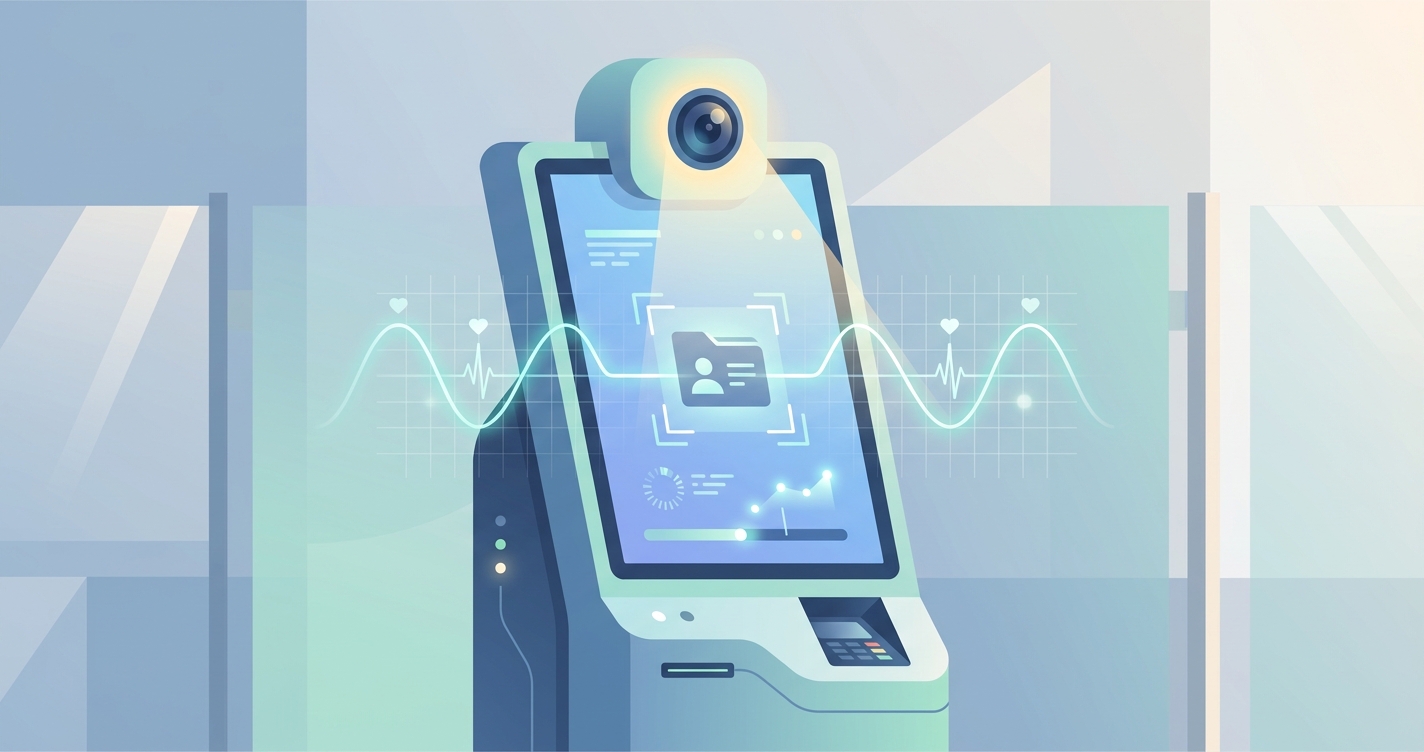
The transition of the waiting room from a passive holding area to an active diagnostic environment is forcing a reassessment of clinical hardware requirements. For decades, hospital administrators and clinic operators have treated administrative registration and physiological triage as two distinct, sequential bottlenecks. However, as hardware manufacturers embed advanced sensing capabilities directly into self-service terminals, the separation between checking in and taking baseline measurements is collapsing. The most significant driver for this hardware convergence is operational efficiency; the automated patient intake benefits allow high-volume clinics to reclaim thousands of hours previously lost to routine manual measurement. By integrating remote photoplethysmography (rPPG) and camera-based vital sign processing into existing hardware platforms, device manufacturers can effectively save up to five minutes of nursing time per patient check-in.
"If only time taking each patient's vital signs at the bedside was considered, after excluding non-vital signs related interruptions, the estimated time was 3 minutes and 45 seconds. Including typical clinical interruptions, that single measurement cycle extends to 6 minutes and 26 seconds."
- Chiara Dall'Ora and Peter Griffiths, "A Time-and-Motion Study of Vital Signs Observations", University of Southampton (2021)
Quantifying automated patient intake benefits for clinical hardware
Every clinical encounter begins with the collection of baseline physiological data. In standard outpatient environments, a medical assistant or triage nurse calls the patient from the waiting room, walks them to a triage station, applies a blood pressure cuff, attaches a pulse oximeter, inserts a thermometer, and manually counts respirations.
This manual process is fundamentally unscalable. According to time-and-motion studies tracking clinical workflows, standard vital sign collection introduces a massive labor cost overhead that electronic health record systems have failed to resolve. Researchers have noted that simply digitizing the documentation phase does not reduce the physical time required to attach peripherals and wait for readings.
For kiosk manufacturers and IoT platform providers, this inefficiency presents a direct commercial opportunity. Building hardware that captures these metrics autonomously during the standard registration workflow shifts the labor burden away from clinical staff and onto the computing edge. If a medical assistant makes $22 per hour, a five-minute triage step costs roughly $1.83 in pure labor per patient. Across a clinic processing 20,000 visits annually, that represents nearly $36,000 in labor spent solely on baseline data collection.
Operational comparison: manual triage vs. automated kiosk intake
| Process Variable | Traditional Manual Triage | Automated Kiosk Intake |
|---|---|---|
| Patient Workflow | Sequential (Registration, then waiting, then triage) | Parallel (Vitals captured concurrently with registration) |
| Clinical Labor Time | 3.5 to 6.5 minutes per patient | 0 minutes (Self-service capture) |
| Hardware Footprint | Dedicated triage room, mobile vital signs cart | Existing check-in terminal or tablet with camera |
| Peripherals Required | BP cuff, pulse oximeter clip, oral thermometer | Embedded camera module, edge AI processor |
| Data Entry | Manual charting or separate barcode scanning | Direct API integration to clinical systems |
For health systems evaluating the total cost of ownership of new check-in hardware, the health kiosk roi centers on labor reallocation rather than strict hardware costs:
- Eliminating a four-minute triage step for a clinic seeing 50 patients a day reclaims over three hours of daily clinical capacity.
- Moving vital sign collection to the waiting room allows clinical staff to focus on diagnostic interpretation rather than basic data gathering.
- Consolidating physiological sensors into a single optical system reduces the procurement and maintenance overhead of replacing broken cuffs and lost oximetry clips.
- Standardizing the capture environment via a fixed kiosk ensures consistent lighting and positioning, reducing measurement variability between different triage nurses.
Industry applications for integrated vitals hardware
Device manufacturers are increasingly targeting specific high-throughput clinical environments where the ability to reduce patient wait times directly impacts facility revenue.
Urgent care and walk-in clinics
Urgent care business models rely entirely on patient velocity. Bottlenecks at the triage station limit the number of patients a facility can process per hour. By deploying kiosks equipped with embedded rPPG technology, these clinics can capture heart rate, respiration rate, and relative stress indicators while the patient taps through their intake forms. When the physician enters the exam room, the baseline physiological data is already populated in the chart.
Corporate health and occupational screening
Employer-sponsored health clinics and occupational screening checkpoints require rapid processing of large employee populations during shift changes. Automated intake hardware allows these facilities to perform baseline health checks without staffing a dedicated triage nurse, drastically lowering the operating costs of the onsite clinic while maintaining daily physiological monitoring.
Retail telehealth pods and unstaffed micro-clinics
Retail pharmacies and commercial grocery chains are increasingly deploying enclosed telehealth pods that connect walk-in patients with remote physicians. In these unstaffed micro-clinics, manual triage is physically impossible because there is no onsite clinical staff. Automated patient intake via integrated camera systems is not merely an efficiency upgrade in this environment; it is a strict functional requirement. Without embedded sensors to capture baseline physiological data, the telehealth pod functions as little more than a video conferencing booth. Integrating optical vitals transforms the kiosk into a fully capable remote diagnostic endpoint.
Current research and evidence
The core argument for upgrading clinical kiosks relies on establishing the true baseline cost of manual observation and comparing it against clinic check-in efficiency metrics. A comprehensive 2021 time-and-motion study by Chiara Dall'Ora, Peter Griffiths, and colleagues at the University of Southampton analyzed the actual time burden of vital sign collection in hospital environments. Their findings revealed that when a nurse conducts a standard vital signs round, the physical measurement takes roughly 3 minutes and 45 seconds per patient. However, when accounting for standard clinical interruptions, that time jumps to 6 minutes and 26 seconds.
Crucially, their research demonstrated that transitioning to electronic vital signs recording systems without changing the fundamental measurement hardware did not yield substantial time savings. The authors found no evidence that nurses save time when using electronic documentation systems alone. The physical act of applying discrete sensors remains the absolute limit on efficiency.
This research explains why embedded optical solutions are gaining traction among medical device engineering teams. By utilizing standard RGB and near-infrared camera modules to perform remote photoplethysmography, hardware providers can extract cardiovascular and respiratory signals from micro-color changes in the patient's facial skin. Because this process is entirely contactless, it bypasses the physical application of sensors that Dall'Ora and Griffiths identified as the primary time sink in clinical triage.
The future of embedded check-in hardware
The next generation of clinical self-service terminals will stop resembling administrative tablets and start functioning as Class II medical devices. As edge computing processors from manufacturers like ARM and Intel become capable of handling real-time computer vision workloads without thermal throttling, the capabilities of the standard waiting room kiosk will expand.
Hardware roadmaps are shifting from simple touch-based data entry toward continuous ambient monitoring. Instead of a patient placing their face in a specific alignment box for a 30-second spot check, future systems will passively analyze physiological signals during the entire 90-second period the patient spends answering registration questions. This continuous capture model improves signal-to-noise ratios and provides a more accurate baseline by filtering out movement artifacts and motion-induced noise.
For IoT platform providers and kiosk engineers, the immediate technical requirement is ensuring that existing camera pipelines and edge processors are specified to handle dense video matrices. The transition toward contactless patient intake is no longer constrained by sensor accuracy, but by the ability of hardware integrators to package complex computer vision models into reliable, high-uptime commercial devices.
Frequently asked questions
How does a self-service kiosk capture vital signs? Modern clinical kiosks utilize remote photoplethysmography (rPPG), a software-based technique that analyzes a live video feed from the kiosk's camera. The system detects micro-variations in the color of the patient's facial skin caused by each heartbeat, translating those optical signals into vital sign metrics like heart rate and respiration.
Why is automated check-in more efficient than manual triage? Manual triage requires a clinician to physically apply multiple sensors, such as a blood pressure cuff, a pulse oximeter, and a thermometer. This standard process takes an average of 3 to 6 minutes per patient. Automated hardware captures this data concurrently while the patient completes digital intake forms, eliminating the physical labor and wait time.
What hardware is required to build a vitals-enabled clinical kiosk? At minimum, integrating automated vitals requires a high-quality camera module (typically RGB or NIR), an edge AI processor capable of running computer vision workloads locally, and proper environmental lighting to ensure clear facial illumination.
Do these systems store patient video data? Enterprise-grade rPPG systems run entirely on the edge. The camera feed is processed frame-by-frame in volatile memory to extract the physiological signal, and the video itself is immediately discarded rather than stored or transmitted to the cloud, ensuring strict data privacy compliance.
Device manufacturers and kiosk engineers are rapidly moving away from passive touchscreens in favor of active, sensor-rich clinical endpoints. Circadify provides the embedded rPPG engine necessary for hardware teams to bring these capabilities to market, delivering contactless vital sign measurement directly on edge processors. For engineering teams evaluating the camera specifications, compute requirements, and software integration steps necessary to deploy automated physiological screening, explore our hardware integration guide for clinical kiosks.