
Can a grocery store kiosk tell me if my blood pressure is too high, for free?
A research look at whether free grocery store health checkup kiosks can flag high blood pressure, what the accuracy data says, and where the hardware is heading.
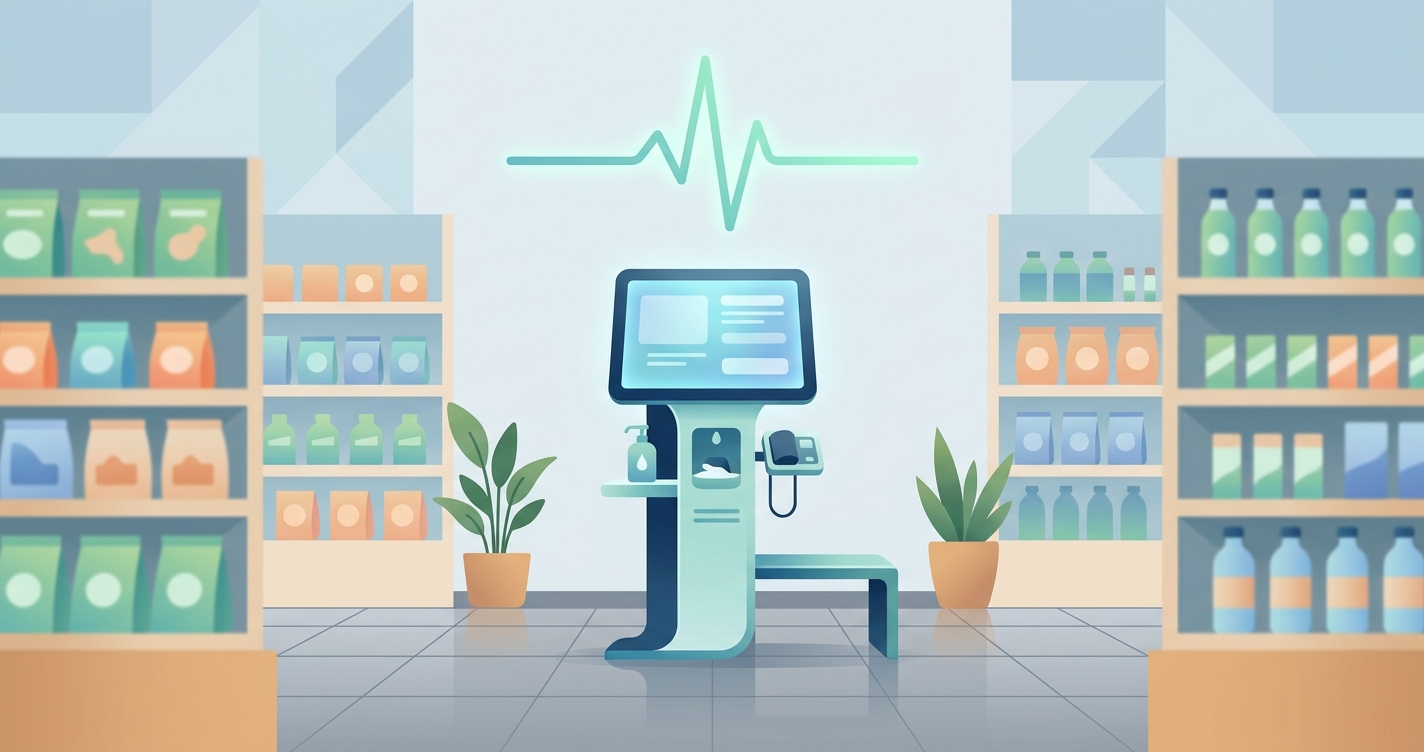
The cuffed machine bolted to the wall near the pharmacy counter has become one of the most-used pieces of medical hardware in the country, and most people walk past it without a second thought. For the kiosk manufacturers and retail solution providers building community health programs, the more interesting question is not whether shoppers will sit down for a free store health checkup, but whether the reading they walk away with means anything. A grocery store kiosk can absolutely tell you that your blood pressure is high in a given moment. Whether that number is trustworthy enough to act on, and what hardware decisions separate a useful screening tool from a false reassurance, is where the engineering and the public health goals collide.
A cross-sectional analysis of more than 1.2 million self-service kiosk users in US retail stores between 2017 and 2024 found that these stations captured elevated blood pressure across populations that national health surveys routinely miss, suggesting retail kiosks can meaningfully extend population screening reach.
What a store health checkup actually measures
A standard retail blood pressure kiosk uses an oscillometric cuff, the same measurement principle as the automated monitors in a clinic. You insert your arm, the cuff inflates, and an algorithm estimates systolic and diastolic pressure from the pressure oscillations it detects. The free store health checkup is genuinely useful for one job: opportunistic screening. It puts a number in front of someone who might not otherwise see a clinician for months, and a clearly elevated reading can be the prompt that sends them to a doctor.
The European Society of Hypertension Working Group on Blood Pressure Monitoring, in a systematic review and consensus statement endorsed by the International Society of Hypertension and the World Hypertension League, acknowledged that public kiosk measurement has real potential for opportunistic screening and long-term monitoring. The same group was careful to note that clinical utility remains uncertain because study designs vary so widely. In other words, the concept works; the execution is inconsistent.
That inconsistency is mostly a hardware and maintenance story, not a science story. The BP-CHECK study, published in 2024, compared home, clinic, and kiosk blood pressure checks for diagnosing hypertension. Kiosk measurements ran significantly higher than 24-hour ambulatory monitoring, with mean differences of roughly 9.5 mmHg systolic and 5.0 mmHg diastolic. A gap that size can push a normal reading into the hypertensive range, which is exactly the kind of error a community health program needs to design around.
Why the cuff is the weak link
The dominant source of error in retail kiosks is not the algorithm. It is the cuff. The American Pharmacists Association has flagged that most pharmacy kiosks ship with a single cuff size that is too small for a large share of the adult population, and an undersized cuff systematically overestimates pressure. A separate systematic review of blood pressure kiosk validation studies found that many of these validations never followed established protocols at all, meaning some devices in the field have never been properly tested against a reference standard.
For a manufacturer, that creates a clear set of failure modes to engineer against:
- Fixed cuff geometry that cannot accommodate large or small arms
- Calibration drift between scheduled maintenance visits
- User technique errors such as talking, crossed legs, or a poorly positioned arm
- High throughput environments where the device is rarely cleaned or serviced
- No way to verify that the last reading was even valid before it is shown to the user
This is the context in which contactless camera-based measurement, or remote photoplethysmography (rPPG), has started to attract attention from kiosk designers. An rPPG embedded system reads subtle color changes in facial skin caused by the cardiac cycle, which removes the cuff entirely along with its sizing and hygiene problems. It is not a drop-in replacement for cuff-based blood pressure today, but it changes the design conversation, especially for heart rate and screening-grade vitals where contactless capture is far more forgiving of user behavior.
Comparing measurement approaches for retail screening
| Measurement approach | Capital and service cost | Accuracy ceiling | Throughput | Hygiene and accessibility | Best fit |
|---|---|---|---|---|---|
| Cuff-based oscillometric kiosk | Low hardware, recurring calibration and cuff service | Good when validated and serviced; degrades with drift and wrong cuff size | One user at a time, 1 to 2 minutes | Shared cuff contact, fixed arm sizing | Pharmacy and grocery BP screening today |
| Contactless rPPG embedded system | Moderate hardware, minimal moving parts | Strong for heart rate and screening trends; BP still maturing | Fast, no inflation cycle | No contact, easier ADA accommodation | High-traffic retail and multi-vital stations |
| Wearable handoff at the kiosk | Low if user owns the device | Varies by consumer device | Depends on user setup | Personal device, no shared surface | Loyalty and follow-up programs |
| Staffed manual check | High labor cost | High with trained operator | Very limited | Trained accommodation | Targeted health fairs |
The table makes the tradeoff explicit. Cuff kiosks are cheap to buy and expensive to keep honest. Contactless approaches move the cost into the hardware and software up front but cut the recurring service burden and the sizing problem that drives most cuff error.
Industry applications for retail and community health
Grocery and big-box retail
A free store health checkup is a footfall and loyalty play as much as a public health one. Retailers want a station that is visible, fast, and rarely out of service. Devices that fail silently, an undersized cuff, a drifted sensor, do real reputational damage because a shopper has no way to know the number is wrong. Embedded vitals monitoring with built-in signal-quality checks lets the station refuse to display a low-confidence reading rather than handing out a misleading one.
Pharmacy chains
Pharmacies sit closest to the care pathway, so an elevated reading can route directly into a pharmacist consultation or a referral. Here the integration question dominates: the kiosk needs to push results into a record system, not just print a slip. Clinical kiosk health screening that connects to a backend turns a passive machine into a referral engine.
Underserved and rural deployments
The 1.2 million-user retail dataset matters most here. Kiosks reach people who do not have a regular clinician, which is precisely the population national surveys undercount. For these sites, an offline-capable, low-maintenance device with contactless vitals device integration removes two of the biggest barriers: connectivity and service access.
Current research and evidence
The evidence base points in two directions at once. On reach, the case is strong. The 2017 to 2024 retail kiosk analysis showed that self-service stations can complement national surveillance and surface elevated blood pressure in hard-to-reach groups. On accuracy, the case is conditional. The BP-CHECK study showed systematic overestimation versus ambulatory monitoring, and home monitoring outperformed both clinic and kiosk readings for diagnosis, adherence, and acceptability. The ESH consensus statement endorses kiosks for screening while withholding judgment on diagnostic use, and the validation-studies review warns that many devices were never tested to standard.
For a device maker, the takeaway is not that kiosks are unreliable. It is that reliability is a design and maintenance variable the manufacturer controls. Accommodating cuff sizes, enforcing validated protocols, building in signal-quality gating, and reducing the number of consumable parts are all engineering levers. Contactless sensing reduces several of these failure modes at the source by removing the cuff and the contact surface from the equation.
The future of the store health checkup
The market is moving in the direction of more stations, not fewer. The global healthcare kiosk market was valued at about 1.47 billion dollars in 2024 and is projected to reach roughly 4.53 billion dollars by 2033 at a compound annual growth rate near 13.3 percent. Growth at that pace will pull retail screening toward multi-vital stations that capture heart rate, respiration, and screening-grade blood pressure in one short interaction.
The likely path is hybrid. Cuff-based measurement stays where regulatory expectations for blood pressure are strict, while contactless rPPG handles the vitals where it already performs well and where hygiene, accessibility, and throughput matter most. As validation work on camera-based blood pressure matures, the cuff becomes one option inside a station rather than the whole station. The winners in this market will be the manufacturers who treat the free reading as a system-reliability commitment, not a marketing feature.
Frequently asked questions
Can a free grocery store kiosk actually detect high blood pressure? Yes, it can flag an elevated reading, and a clearly high result is a legitimate reason to see a clinician. But research such as the 2024 BP-CHECK study shows kiosks tend to read higher than reference monitoring, so a single number should be treated as a screening signal rather than a diagnosis.
Why are kiosk readings sometimes inaccurate? The most common causes are an undersized cuff, calibration drift between service visits, and user technique like talking or poor arm position. The American Pharmacists Association has specifically warned that many pharmacy kiosk cuffs are too small for a large share of adults.
How does contactless rPPG change the accuracy picture? By removing the cuff, rPPG eliminates cuff-sizing and hygiene errors and speeds up screening. It is already strong for heart rate and screening trends, while camera-based blood pressure is still maturing, so most designs treat it as a complement rather than a full replacement.
Is a store health checkup a substitute for a doctor visit? No. It is a screening tool. Home monitoring outperformed kiosk readings for diagnosis in published research, and any concerning result from a retail station should be confirmed with a clinician.
Circadify is building toward this exact problem space, with an embedded rPPG engine designed to drop into kiosks, tablets, smart displays, and clinical hardware so retail and community screening stations can capture contactless vitals without the cuff-maintenance burden. Teams evaluating a retail or pharmacy deployment can start with the hardware integration guide at circadify.com/custom-builds/clinical-kiosks.