
Contactless Vitals vs Pulse Oximeter for Kiosks
A technical comparison of contactless vitals vs pulse oximeter hardware for self-service kiosks: accuracy, hygiene, throughput, and cost for device makers.
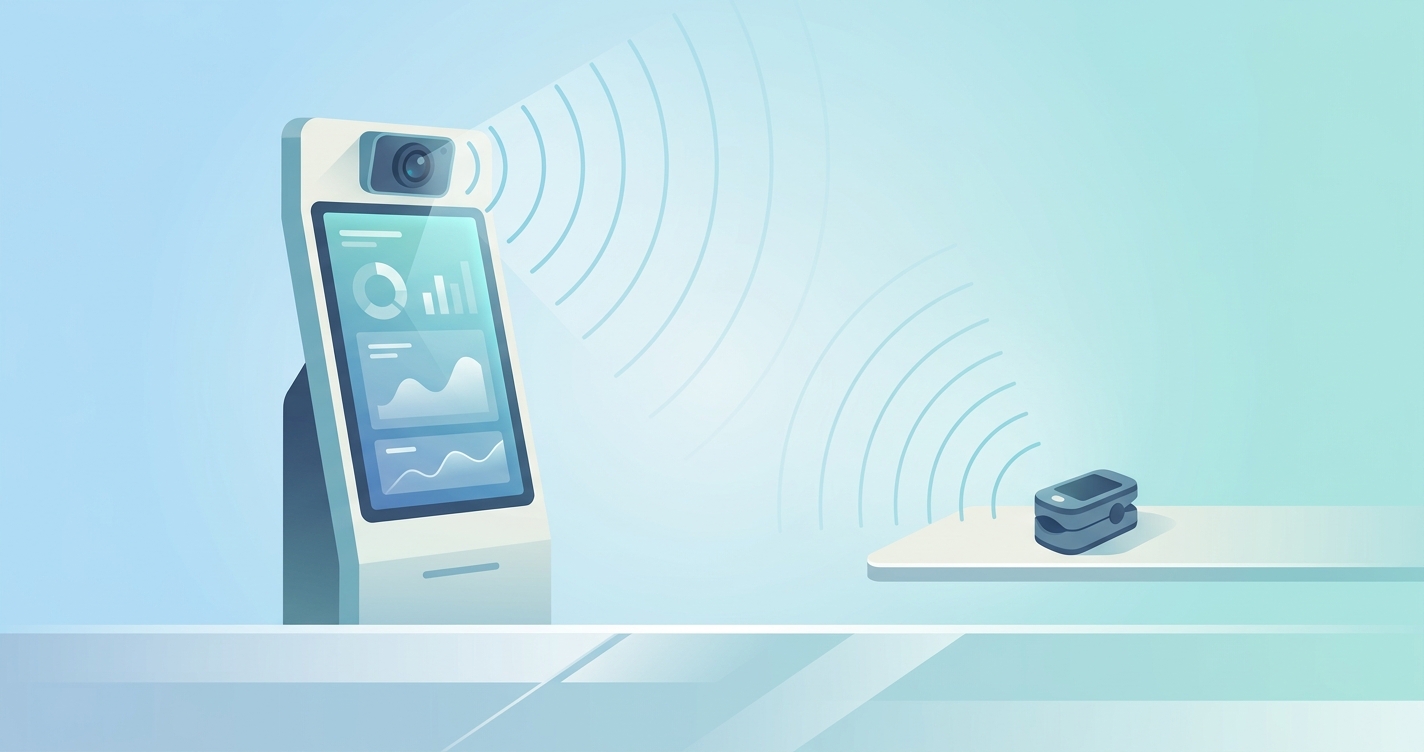
For a decade, the finger clip was the default answer to the question of how a kiosk measures a heartbeat. A pulse oximeter is cheap, small, and familiar, so it ended up bolted onto nearly every self-service health station shipped. That default is now under real pressure. The debate over contactless vitals vs pulse oximeter hardware is no longer a research curiosity for kiosk manufacturers and medical device companies; it is a procurement decision driven by hygiene expectations, throughput math, and a growing body of evidence about where finger sensors quietly fail. This report compares camera-based remote photoplethysmography (rPPG) against the traditional finger clip across the four metrics that actually decide a kiosk's unit economics.
A 2020 study by Michael Sjoding and colleagues at the University of Michigan, published in the New England Journal of Medicine, found that Black patients had nearly three times the frequency of occult hypoxemia, where a pulse oximeter reads a reassuring 92 to 96 percent while arterial oxygen sits below 88 percent, compared with White patients. For a public-facing kiosk that screens an unselected population, that bias is not an edge case.
Contactless vitals vs pulse oximeter: how the two approaches actually differ
Both technologies read the same underlying signal, the optical pulse wave created when blood volume changes with each heartbeat. The difference is geometry. A pulse oximeter presses two LEDs and a photodiode against a fingertip and measures transmitted light. A camera-based system uses an ordinary RGB or near-infrared sensor to detect the same micro-color changes in facial skin from a short distance, then reconstructs the waveform in software. That single architectural choice, contact versus camera, cascades into every other tradeoff a kiosk team cares about.
The finger clip's strength is signal strength. Pressing an emitter against perfused tissue produces a high signal-to-noise ratio, which is why transmission pulse oximetry remains the reference for SpO2. Its weaknesses are physical and operational: it must be touched by every user, it depends on adequate peripheral perfusion, and its accuracy is sensitive to skin pigmentation, nail polish, cold hands, and motion. Camera vitals trade some raw signal quality for a contactless capture that sidesteps the hygiene and queue problems that plague shared finger sensors.
| Factor | Finger pulse oximeter | Contactless camera vitals (rPPG) |
|---|---|---|
| Contact required | Yes, shared surface per user | No, captured at distance |
| Heart rate accuracy | High, reference grade | MAE roughly 1 to 5 bpm in validation studies |
| SpO2 accuracy | Reference standard, but pigment bias | Emerging, reported error around 2 percent in controlled settings |
| Hygiene | Requires cleaning between users | No shared contact surface |
| Throughput | Limited by placement and cleaning | Faster, no physical positioning |
| Per-station BOM | Low sensor cost, ongoing consumable and cleaning cost | Reuses existing camera, software-driven |
| Accessibility | Fails on tremor, prosthetics, long nails | No dexterity requirement |
| Known failure modes | Perfusion, motion, pigment, polish | Lighting, motion, elevated heart rate |
Accuracy: where finger clip vs camera vitals each win and lose
Accuracy is rarely a single number, and treating it that way is how kiosk programs get burned. For heart rate, the gap between the two technologies is narrow. A 2023 clinical validation of rPPG software in cardiovascular disease patients reported a mean absolute error of about 1.06 bpm against ECG, and broader reviews place camera-based heart rate MAE between roughly 0.23 and 5 bpm depending on conditions. A finger clip will generally beat that under poor lighting or heavy motion, but for a stationary user at a kiosk the difference is often clinically negligible.
SpO2 is where the comparison gets honest. Transmission pulse oximetry remains the more mature measurement, and camera-based SpO2 is still an emerging capability, with controlled studies reporting errors near 2 percent. But the finger clip's reference status comes with an asterisk that the Sjoding work made impossible to ignore: systematic overestimation in darker skin. A non-contact camera does not eliminate pigment effects, yet it captures from a larger skin region and can be calibrated across diverse cohorts in software rather than hardware. The practical takeaway for device makers:
- For heart rate and heart rate variability, camera capture is competitive with a finger clip in kiosk conditions.
- For SpO2, the finger clip is still more mature, but carries a documented demographic bias that a public kiosk cannot easily exclude.
- rPPG accuracy degrades at elevated heart rates and under unstable lighting, so environmental control matters more than for a contact sensor.
- Both approaches need motion handling; neither performs well on a moving subject.
Industry Applications
Clinical kiosk health screening
In a clinic lobby, the binding constraint is usually throughput and infection control, not laboratory-grade precision. A clinical kiosk health screening flow that captures heart rate, respiration, and an estimated SpO2 from the face while the patient completes check-in removes a physical bottleneck. There is no clip to position, no surface to wipe between an unbounded stream of strangers, and no failed reads from cold or callused fingers. For a triage-grade first pass that flags who needs a clinician's cuff, contactless capture fits the workflow better than a shared finger sensor.
Retail, pharmacy, and workplace stations
High-traffic public stations expose the finger clip's worst operational property: every user touches the same sensor. Even with diligent cleaning, perceived hygiene suppresses usage, and cleaning labor is a recurring cost that never appears in the sensor's purchase price. Contactless vitals device integration lets a retail or workplace kiosk run hands-free, which raises completion rates and removes the consumable and sanitation overhead entirely.
Embedded vitals monitoring in existing hardware
For IoT platform providers and device companies, the most compelling case is that the camera is often already there. A tablet, smart display, or check-in terminal usually ships with an imaging sensor for face capture or video. An embedded vitals monitoring engine that runs on that existing camera adds a measurement capability without a new physical part, new placement engineering, or a new cleaning protocol. The finger clip, by contrast, is always an added component with its own enclosure, wiring, and failure surface.
Current research and evidence
The literature has shifted from asking whether rPPG works to characterizing exactly when it works. A 2023 current review of remote photoplethysmography, published on medRxiv, documents heart rate accuracy approaching reference methods under controlled conditions while flagging motion and illumination as the dominant error sources. A separate 2023 validation in cardiovascular patients reported strong ECG agreement for pulse rate. Researchers at the University of St Andrews have reviewed the harder problem of camera-based blood oxygenation, where the physics is less forgiving and results remain more variable than for heart rate.
On the pulse oximeter side, the evidence runs the other direction, toward documented limits. The Sjoding study and subsequent systematic reviews establish that pigment-related bias in transmission oximetry is real, reproducible, and clinically consequential, with concerns first raised in the 1990s and quantified at scale only recently. That body of work reframes the comparison: the finger clip is not a bias-free gold standard against which the camera must prove itself, but a mature sensor with a known and unequal failure mode. For a kiosk serving the general public, both technologies carry uncertainty that has to be designed around rather than assumed away.
The Future of contactless vitals for kiosks
The trajectory points toward hybrid and software-defined measurement rather than a single winner. Several developments are converging:
- Multi-region facial sampling and better motion models are narrowing the camera's gap with contact sensors, especially for heart rate and respiration.
- On-device, edge processing keeps face data local, which removes the privacy objection that once stalled camera vitals programs.
- Regulators are tightening expectations around demographic performance, which pressures any pigment-sensitive measurement regardless of form factor.
- As cameras become standard on kiosks and tablets, the marginal cost of adding software-based vitals approaches the cost of the engine alone.
The likely endpoint is not the finger clip's disappearance from every use case but its retreat to settings that need reference-grade SpO2, while contactless capture becomes the default for screening, triage, and high-traffic public stations.
Frequently asked questions
Is a contactless camera as accurate as a finger pulse oximeter?
For heart rate, validation studies place camera-based error within a few beats per minute of reference methods, which is competitive in stationary kiosk conditions. For SpO2, transmission pulse oximetry is still the more mature measurement, though it carries a documented pigment bias. The right choice depends on whether the kiosk needs reference-grade oxygen saturation or screening-grade triage.
Why does hygiene favor contactless vitals at a kiosk?
A finger clip is a shared contact surface touched by every user, which requires cleaning between sessions and suppresses usage when people hesitate to touch it. A camera captures at a distance, so there is no shared surface, no sanitation labor, and no consumable cost tied to each measurement.
How does throughput compare between finger clip and camera vitals?
Camera capture removes physical positioning and between-user cleaning, the two steps that slow a finger-clip station most. For high-traffic deployments this raises completion rates and shortens the per-user cycle, which is often the deciding factor in a public-facing kiosk's economics.
Can we add contactless vitals to a kiosk that already has a camera?
In most cases yes. Many kiosks, tablets, and smart displays already include an imaging sensor, and an embedded rPPG engine can run on that existing camera. This avoids a new physical sensor, new enclosure work, and the cleaning protocol a finger clip demands.
Circadify is building toward exactly this transition, an embedded rPPG engine designed to run on the cameras kiosks and clinical hardware already ship with, so manufacturers can retire the shared finger clip without adding parts. Teams scoping a touchless upgrade can start with the hardware integration guide for clinical kiosks at circadify.com/custom-builds/clinical-kiosks.