
5 Industries Putting Contactless Vitals in Everyday Devices
A look at the contactless vitals device industries adopting camera-based rPPG beyond healthcare, with market data and embedded vitals monitoring use cases.
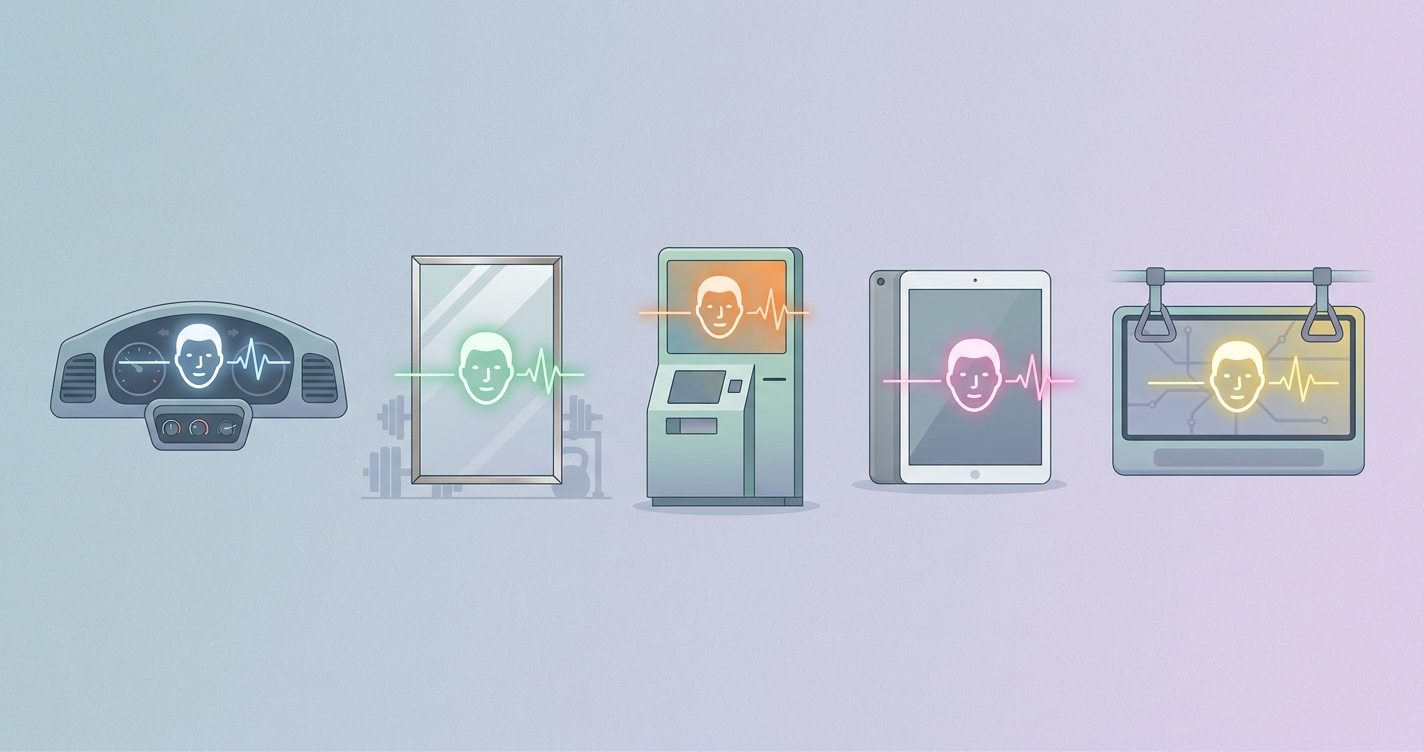
Camera-based vital sign measurement spent most of the last decade framed as a hospital and telehealth feature, but the buyers asking for it now sit in product teams far outside clinical software. Remote photoplethysmography (rPPG) reads the small color changes a pulse produces in facial skin, and because it needs only a standard camera and compute, it slots into hardware that ships in millions of units. That economic fact is reshaping the contactless vitals device industries that matter to anyone scoping an embedded sensor roadmap, and it is opening embedded vitals monitoring use cases that were never on a medical device manager's whiteboard five years ago.
"The contactless health monitors market was valued at $5.5 billion in 2025 and is projected to grow to $15 billion by 2035, at a compound annual growth rate of 10.6 percent." - WiseGuyReports, 2025
The pull is no longer purely about diagnosis. A pulse, respiration rate, and a stress estimate are now treated as ambient context that improves a product already being built for another reason. That reframing is why this technology is crossing into transportation, fitness, retail, remote care, and public infrastructure at the same time.
Why the contactless vitals device industries are converging now
Three things changed at once. Edge silicon got cheap enough to run signal extraction on-device, removing the privacy and bandwidth penalties of streaming video to a server. Camera modules already exist in most of the target hardware, so the marginal bill-of-materials cost is software plus tuning rather than a new sensor. And the measurement quality reached a level that product teams can defend. A 2023 systematic review and meta-analysis in PMC reported consumer-grade contactless monitors hitting a mean absolute error of about 0.36 beats per minute for heart rate against reference devices, which is more than adequate for screening and wellness contexts.
The result is that IoT health sensor applications no longer require a dedicated medical product. They ride on devices people already touch, stand in front of, or sit inside. The five sectors below are where the demand signal is clearest.
| Industry | Typical device | Primary vitals used | Main driver | Regulatory weight |
|---|---|---|---|---|
| Automotive | In-cabin driver camera | Heart rate, fatigue, stress | Safety mandates | Moderate to high |
| Fitness and wellness | Smart mirrors, check-in screens | Heart rate, recovery, stress | Member engagement | Low |
| Retail and pharmacy | Self-service kiosks | Blood pressure proxy, pulse | Foot traffic, screening | Moderate |
| Remote care platforms | Tablets, laptops, smart displays | Heart rate, respiration | Visit data capture | High |
| Public infrastructure | Building and transit screens | Pulse, ambient screening | Throughput, duty of care | Variable |
The common thread is that none of these buyers is selling a vitals monitor. They are adding a physiological layer to a device whose core job is something else, which changes how the feature must be scoped, integrated, and supported.
Industry Applications
Automotive and in-cabin monitoring
Driver monitoring is the fastest-moving non-clinical adopter. The driver monitoring systems market reached roughly USD 5.2 billion in 2025 and is projected to grow to USD 5.7 billion in 2026, with camera-based systems estimated to hold around 48 percent of that market by 2026. A 2024 systematic review on AI innovations in rPPG for driver monitoring described heart rate and stress estimation as core inputs to fatigue and impairment detection, alongside eye and head tracking. The narrower automotive active health monitoring segment was valued at USD 807 million in 2025 and is forecast to reach USD 2,695 million by 2032.
What makes this sector demanding is the environment. Lighting shifts constantly, the subject moves, and skin tone diversity in training data remains an open problem the same review flagged. Product teams here need an engine tuned for motion tolerance, not a lab-grade pipeline.
Fitness and wellness hardware
Gyms, smart mirrors, and recovery studios want a contactless reading because it removes the friction of strapping on a chest band. The device captures heart rate at check-in or during a session and feeds it back as recovery or effort context. The accuracy bar is forgiving compared to clinical use, which is why this is one of the lowest-regulatory-weight entry points for camera vitals. A note of caution sits underneath the marketing: a 2025 study covered by The Guardian found that smartwatch stress scores correlated poorly with self-reported stress, a useful reminder that stress estimation specifically is still maturing even where heart rate is solid.
Retail and pharmacy kiosks
The cuffed blood pressure machine near the pharmacy counter is one of the most-used pieces of consumer medical hardware, and contactless screening is the natural next iteration. Clinical kiosk health screening markets benefit from existing retail foot traffic, turning a check-in screen into a quick screening touchpoint. The appeal for operators is throughput: no consumables, no cuff sanitation, no queue at a single fixed station.
Remote care and telehealth platforms
A video visit already streams the patient's face, so capturing heart rate and respiration from that same feed costs almost nothing in hardware. Microsoft Research has published extensively on contact-free physiological measurement from consumer cameras for telehealth, and this is the use case with the highest regulatory weight because the output is fed into a clinical workflow. That raises the bar for documentation and validation but also makes the value per measurement the highest of any sector here.
Public infrastructure and smart spaces
Airports, transit hubs, and large buildings are experimenting with ambient screening built into existing displays. The driver is throughput and duty of care rather than diagnosis, and the regulatory picture varies sharply by jurisdiction and use. This is the most speculative of the five, but it is also where embedded vitals monitoring use cases scale to the largest installed device bases.
- Lowest barrier to entry: fitness and wellness, because accuracy tolerance is wide and oversight is light.
- Highest value per reading: remote care, where each measurement informs a clinical decision.
- Largest device volume: public infrastructure and automotive, where cameras already ship at scale.
- Most consumer familiarity: retail and pharmacy, which inherit trust from existing screening stations.
Current research and evidence
The evidence base now supports heart rate strongly and other vitals with more caution. The PMC meta-analysis cited above places contactless heart rate measurement close to reference standards, while noting that contactless blood pressure and respiratory rate need further study. Frontiers and MDPI review papers from recent years describe the field moving toward multi-modal, multi-task models that estimate several signals from one video stream, which is exactly what a multi-industry engine needs.
Stress detection is the most contested signal. Work by Tiwari and colleagues on non-invasive stress monitoring from video reported over 84 percent classification accuracy by combining remote heart rate with facial analysis, yet the smartwatch findings reported in 2025 show how easily stress claims outrun the data. For device makers, the practical takeaway is to lead with heart rate and respiration, treat blood pressure as a screening proxy with clear disclaimers, and position stress as exploratory rather than clinical. On the consumer-electronics side, the photoplethysmography biosensors market is forecast at USD 0.7 billion in 2026 with smartwatches taking roughly 43 percent, evidence that physiological sensing has already normalized in everyday hardware.
The future of contactless vitals device industries
The next phase is consolidation around shared engines. Rather than each sector building its own pipeline, the same on-device rPPG core gets retuned for a car cabin, a gym mirror, or a pharmacy kiosk, with the environment-specific work concentrated in lighting, motion handling, and the host application. Expect three shifts over the next few years:
- Edge-first by default, so face data never leaves the device, which resolves the privacy objection that stalls many deployments.
- Tiered claims by sector, where the same measurement is described as wellness in a gym and as screening in a clinic, with documentation matched to the regulatory weight.
- Standardized integration paths, so a kiosk maker or IoT platform can add vitals as a module rather than a research project.
The companies that win will be the ones that treat the engine as portable infrastructure and the industry context as a configuration problem.
Frequently asked questions
Which industries are adopting contactless vitals fastest?
Automotive driver monitoring and fitness or wellness hardware are moving quickest. Automotive is pulled by safety regulation and large camera volumes, while fitness benefits from a low regulatory bar and an easy engagement story. Retail kiosks, telehealth, and public infrastructure follow with heavier compliance or integration considerations.
Do these non-healthcare uses need the same accuracy as a hospital?
No. The required accuracy scales with the claim. A gym positioning heart rate as effort context has a far lower bar than a telehealth platform feeding data into a clinical record. Heart rate measurement is well validated across contexts, while blood pressure and stress estimates warrant more caution and clearer disclaimers.
What hardware is actually required to add camera vitals?
In most cases a standard RGB camera plus enough on-device compute to run signal extraction at the edge. Because the target devices usually already include a camera, the marginal cost is software, tuning, and validation rather than a new sensor, which is the main reason adoption is spreading across so many device categories.
Is camera-based vitals data private?
It can be, when processing runs on the device and only the resulting numbers are stored or transmitted. Edge-first architectures mean raw face video never leaves the hardware, which addresses the most common privacy objection product teams hear from end users and procurement.
Circadify is building toward this space with an embedded rPPG engine designed to drop into kiosks, tablets, smart displays, and clinical hardware across these industries. Teams evaluating a contactless vitals feature can review the hardware integration guide for clinical kiosks at circadify.com/custom-builds/clinical-kiosks to scope an opportunity assessment for their own device category.