
Camera Vitals vs. Sensor Strips: Which Is Better for IoT?
A detailed analysis of contactless vitals vs contact sensors for IoT health applications. Compare hardware costs, hygiene, and data richness for connected devices.
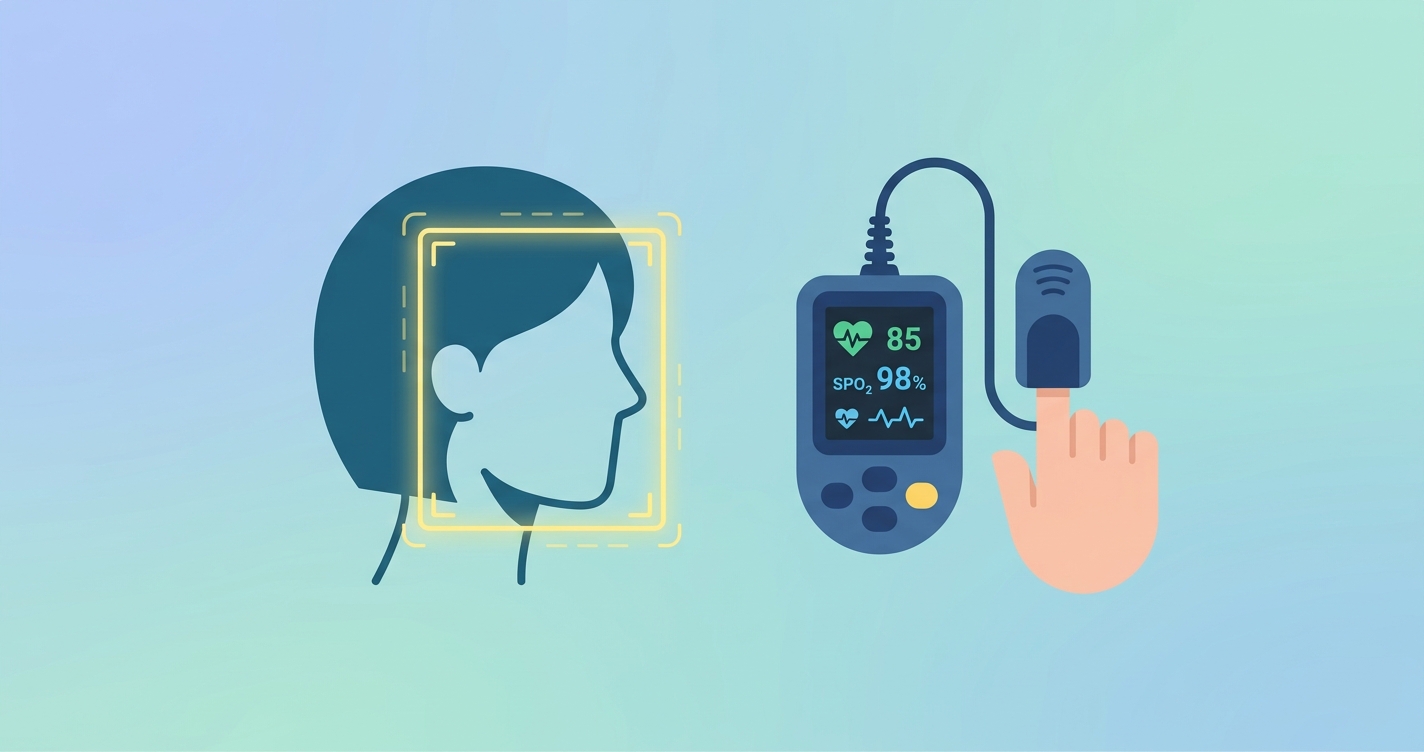
The physiological measurement stack for connected hardware is undergoing a rapid transition. Historically, capturing metrics like heart rate or respiration required dedicated physical peripherals bolted onto the primary device. Today, product managers face a different architectural decision. The debate over contactless vitals vs contact sensors has moved from research laboratories directly into procurement discussions for connected deployments. As platforms expand to monitor population health at scale, relying on single-purpose wearable modules introduces significant hardware cost and supply chain complexity. Evaluating these two modalities requires looking beyond basic bench accuracy to understand total operational efficiency and the realities of fleet management.
"The global IoT in healthcare market, valued at $44.2 billion in 2023, is increasingly driven by remote patient monitoring modalities that reduce hardware dependency while maintaining clinical utility." (Grand View Research, 2023)
The hardware bill of materials: contactless vitals vs contact sensors
Building a health-enabled device requires mapping out a strict bill of materials. For decades, the standard approach to IoT health monitoring relied on contact sensors. If a kiosk or smart tablet needed to measure a pulse, engineers integrated a hardware pulse oximeter via USB or an I2C interface. If it needed blood pressure, they attached a mechanical cuff.
This legacy approach creates a linear cost curve. Every new physiological metric requires a new physical component, an updated firmware driver, and additional space on the chassis. Contact sensors also introduce mechanical points of failure. Wires fray, adhesives lose their grip, and plastic clips break under high-volume public use.
Camera-based remote photoplethysmography (rPPG) flips this architectural model from hardware to software. By analyzing the micro-vascular changes in human skin driven by the cardiac cycle, an rPPG engine extracts vital signs using standard RGB camera sensors. Because a lens can capture the entire face simultaneously, a single camera can theoretically calculate heart rate, respiration rate, and heart rate variability all at once. The hardware cost is limited to an imaging module that is likely already present in the device design for video calling or security purposes.
When comparing contactless vitals vs contact sensors, engineering teams must evaluate several core constraints:
| Specification | Contact Sensors (Clips, Cuffs, Leads) | Camera Vitals (Embedded rPPG Engine) |
|---|---|---|
| Recurring Hardware Cost | High (per-unit component sourcing) | Low (uses existing optical lenses) |
| User Friction | High (requires physical application) | Zero (passive ambient measurement) |
| Hygiene and Sterilization | Requires strict chemical wipedowns | Contactless by default |
| Data Richness | Single-signal (one device per metric) | Multi-signal (HR, HRV, respiration) |
| Mechanical Breakage Risk | High (cords, tubes, physical hinges) | Low (solid-state camera modules) |
Relying on traditional contact hardware introduces several operational bottlenecks for IoT fleet managers:
- Physical deterioration of adhesive strips and mechanical cuffs over time requires constant maintenance.
- Increased risk of cross-contamination necessitates robust sterilization workflows between users.
- Recurring procurement costs for single-use consumables reduce the profitability of the deployment.
- Slower user throughput occurs because individuals must manually apply and calibrate physical sensors.
Industry applications for iot platforms
The shift toward software-defined sensors is unlocking new form factors across the connected hardware industry. By removing the need for physical tethers, manufacturers are deploying physiological measurement in environments where contact sensors were previously impossible to maintain.
Smart kiosks and clinical check-in
In waiting rooms and pharmacies, check-in kiosks are transitioning from simple touchscreens to comprehensive triage stations. A traditional kiosk equipped with physical blood pressure cuffs and finger clips requires constant supervision by a nurse to ensure the equipment is sanitized and functioning correctly. Camera-based measurement allows the kiosk to capture a baseline pulse and respiration rate passively while the user types in their demographic information. This parallel processing speeds up the check-in queue and reduces overhead for clinic staff.
Ambient telehealth endpoints
Telehealth platforms are moving away from software-only video calls toward integrated hardware endpoints. Whether in a rural clinic or an assisted living facility, these dedicated endpoints act as continuous monitoring stations. Contact sensors are often too cumbersome for elderly patients to apply correctly without assistance. Ambient camera monitoring allows the endpoint to gather vital sign trends naturally during a conversation, removing the user error associated with placing a wearable strap or aligning a finger clip.
Commercial driver and operator monitoring
In industrial and automotive IoT, monitoring operator fatigue and physiological stress is a critical safety requirement. Wiring a heavy machinery operator with an electrocardiography strap is highly impractical and introduces physical hazards. Embedded rPPG running on an edge compute module can analyze the operator's face from the dashboard, tracking heart rate variability to detect early signs of drowsiness without obstructing their range of motion.
Current research and evidence
The academic consensus regarding optical measurement has solidified over the last three years, moving from feasibility studies to direct clinical comparisons.
In a 2023 study published via Elsevier, researchers Al-Naji et al. evaluated remote photoplethysmography against traditional electrocardiography for monitoring vulnerable populations. The study demonstrated that in stable conditions, camera-based measurement achieved high parity with physical contact leads. The researchers successfully extracted continuous physiological signals without subjecting the patients to the physical stress of adhesive electrodes.
Similarly, a 2024 review by Gibson et al., also published in ScienceDirect, analyzed the broader opportunities of continuous physiological monitoring. The review highlighted that while traditional contact sensors still maintain an advantage during severe motion artifacts, camera-based methods are uniquely positioned for long-term, unobtrusive monitoring. The literature indicates that as computer vision algorithms become more robust to lighting variations and diverse skin tones, the gap in raw signal acquisition between the two modalities continues to close.
This research highlights a crucial engineering trade-off. Contact sensors provide maximum accuracy during extreme physical movement, making them strictly necessary for intensive care units or athletic monitoring. However, for stationary IoT deployments like kiosks, interactive mirrors, or desktop telehealth terminals, the user is generally still and well-lit. In these structured environments, camera vitals deliver clinical-grade utility without the mechanical friction of a physical probe.
The future of iot health sensors
The next generation of IoT devices will rely heavily on localized edge computing rather than cloud processing. Historically, analyzing heavy video streams for rPPG required sending frames to a remote server, which introduced unacceptable latency and severe privacy concerns. Modern advancements in edge processing capabilities mean that embedded chips can now run neural networks locally.
This localized architecture ensures that no raw video ever leaves the device. The camera sensor captures the video, the edge processor extracts the vascular signal to compute the vitals, and only the final numerical data is transmitted to the cloud via secure MQTT protocols. This approach drastically reduces bandwidth costs and satisfies strict data privacy regulations, making ambient monitoring scalable across global fleets.
As edge processors become cheaper and more powerful, the reliance on external contact sensors will decrease further. Software-defined health monitoring allows manufacturers to update the diagnostic capabilities of a device entirely over the air. Instead of shipping a new hardware module to thousands of clinics, an IoT platform can simply deploy a firmware update to unlock new physiological metrics.
Frequently asked questions
How does the accuracy of rPPG compare to contact sensors? Research indicates that in well-lit, stable environments, remote photoplethysmography achieves near-parity with contact-based photoplethysmography. However, traditional contact sensors still provide more robust signal acquisition during high-motion activities or in complete darkness.
Can camera vitals run entirely on existing IoT edge devices? Yes. Modern edge computing architectures allow rPPG models to process video frames locally on embedded ARM or x86 chips. This prevents raw video data from being transmitted to the cloud, ensuring high privacy and low latency.
Why are kiosk manufacturers switching to contactless vitals? Eliminating physical cuffs and finger clips removes mechanical failure points, reduces ongoing maintenance and cleaning costs, and speeds up the user check-in process by making measurement entirely passive.
Does switching to software sensors lower the bill of materials? Yes. Consolidating multiple hardware peripherals into a single software engine running on an existing RGB camera drastically reduces both the upfront per-unit component cost and the recurring supply chain overhead.
When hardware developers reach the limits of what physical probes can achieve, shifting to a software-defined architecture becomes the clear path forward. Circadify is actively addressing this space by providing an embedded rPPG engine built specifically for modern connected devices. For IoT platform providers and kiosk manufacturers ready to eliminate peripheral hardware, read our technical hardware integration guide at circadify.com/custom-builds/clinical-kiosks to see how camera-based measurement scales in production environments.