
What Is an Ambient Health Sensor? Embedded Vitals for Smart Spaces
A research-based look at ambient health sensor embedded vitals for smart spaces, including cameras, radar, edge hardware, privacy design, and deployment models.
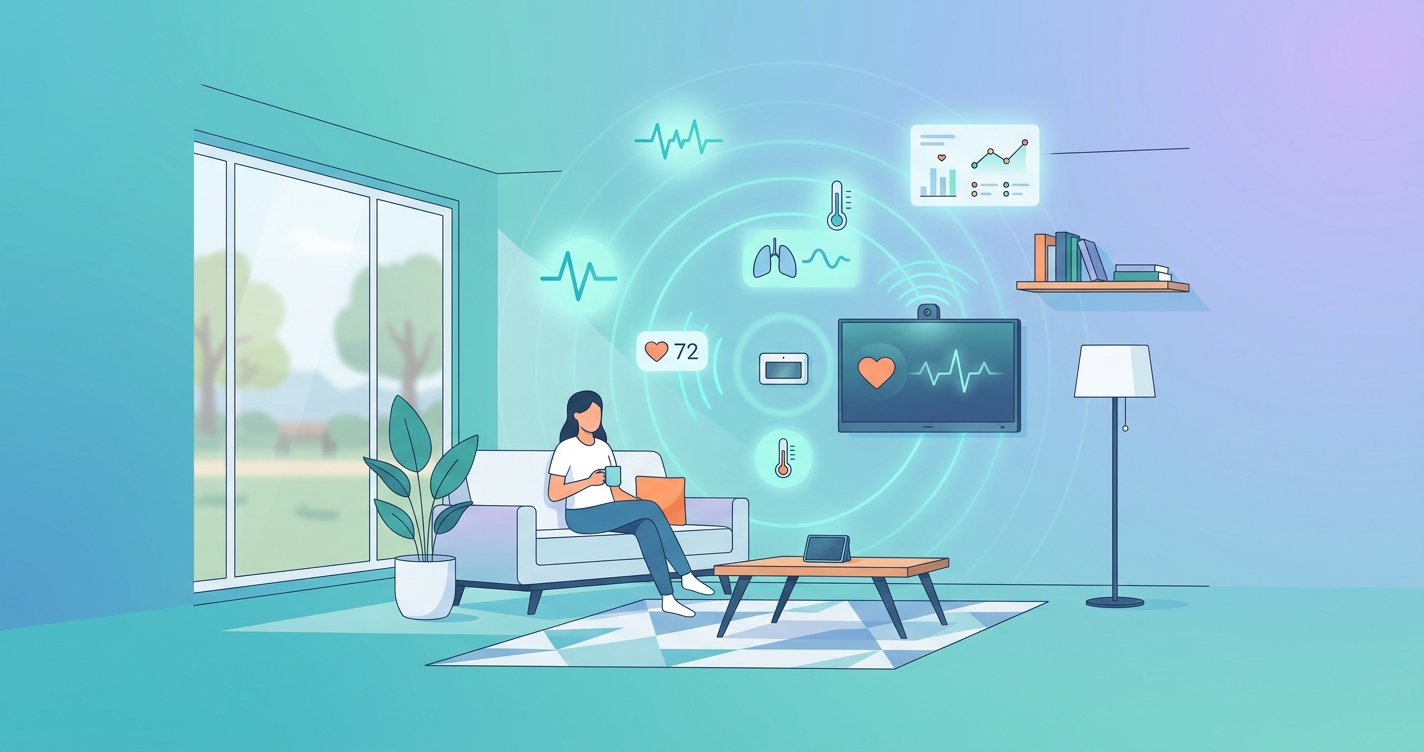
Ambient health sensor embedded vitals smart spaces are starting to move from research projects into real product planning. The idea is simple enough: instead of asking a person to wear a device or stop at a kiosk, the room itself becomes part of the sensing system. Cameras, radar, thermal sensors, and edge processors sit quietly in the background and watch for physiological signals that can support screening, triage, or ongoing monitoring. The hard part is not the concept. The hard part is making it work reliably in real spaces where people move, lighting changes, and privacy expectations are high.
"Noncontact sensors for vital sign measurement require further technical development but offer solutions to issues with traditional devices." — Yoo Jin Choo, Gun Woo Lee, Jun Sung Moon, and Min Cheol Chang, Medical Science Monitor, 2024
Ambient health sensor embedded vitals smart spaces: what the term really means
An ambient health sensor is not one device. It is usually a sensing layer built into a room, kiosk bay, bedside setup, smart display, or wall-mounted endpoint. Instead of attaching a cuff, clip, or patch, the system reads signals from a distance and turns them into workflow data.
In practice, that usually means some mix of these components:
- RGB or infrared cameras for remote photoplethysmography and motion analysis
- radar modules for respiration and micro-movement detection
- thermal sensors for skin-temperature patterns and occupancy context
- microphones or environmental sensors for context, not diagnosis
- edge compute for local processing, filtering, and API handoff
The phrase "smart spaces" matters here. Embedded vitals are easier to trust when the environment is partly controlled. A waiting room alcove, patient bay, exam-room wall unit, or senior living common area gives engineers a better shot at stable distance, sight lines, and lighting than a random living room corner.
| Ambient sensing model | Typical sensor stack | Best fit | Main engineering constraint |
|---|---|---|---|
| Clinical kiosk bay | RGB camera, illumination, optional thermal, edge box | Check-in and guided screening | User positioning |
| Smart room endpoint | Camera plus radar with local processor | Passive periodic monitoring | Privacy and room variability |
| Bedside or chair-side monitor | Radar, thermal, depth or RGB | Recovery, elderly care, step-down units | Motion noise |
| Smart display or tablet dock | Embedded camera and on-device inference | Self-service health interactions | Camera quality and compute budget |
| Large public-space node | Multi-sensor ceiling or wall unit | Throughput and occupancy awareness | Signal quality at distance |
Why developers and device makers care about ambient sensing now
I keep coming back to one boring but important reason: wearables and contact devices create operational friction. They have to be charged, cleaned, fitted, replaced, explained, and tolerated. Ambient sensing is attractive because it removes part of that burden.
That does not automatically make it better. Ahmed Alboksmaty, N. Solomons, S. Gul, A.L. Neves, and P. Aylin found in their systematic review on home monitoring with ambient sensors that the evidence base is still limited, even though the model shows promise for older adults and home care. That is where the market sits right now. There is genuine pull from health systems, device teams, and IoT builders, but there is still a gap between technical feasibility and broad clinical workflow proof.
For embedded product teams, the near-term opportunity is clearer in settings where the environment can be shaped:
- clinical kiosks
- waiting room screening zones
- smart displays in exam or triage rooms
- senior living spaces with repeatable furniture layouts
- device enclosures that control viewing angle and distance
That is a more realistic starting point than pretending every ambient sensor works equally well in every room.
The sensing stack behind embedded vitals for smart spaces
The literature is pretty consistent on this point: no single sensor wins everywhere. Linas Saikevičius, Vidas Raudonis, Gintaras Dervinis, and Virginijus Baranauskas wrote in their 2024 systematic review of non-contact vision-based vital sign monitoring that camera-based systems can estimate heart rate and respiratory rate well under controlled conditions, but they still struggle with motion, illumination changes, and subject variability.
Vinothini Selvaraju, Nicolai Spicher, Ju Wang, Nagarajan Ganapathy, Joana M. Warnecke, Steffen Leonhardt, Ramakrishnan Swaminathan, and Thomas M. Deserno reached a similar conclusion in their 2022 systematic review of camera-based vital sign monitoring. After screening 905 papers, they found the field moving quickly across heart rate, respiratory rate, temperature, SpO2, and blood pressure estimation, but with performance that depends heavily on modality and context.
That is why smart-space design increasingly looks multimodal.
Cameras
Cameras are useful because they are already everywhere. They can support rPPG, respiration estimation, occupancy awareness, and user guidance. They also raise immediate questions about lighting, skin tone robustness, and privacy handling.
Radar
Radar is appealing when teams want low-light performance, passive respiration monitoring, or less visually sensitive capture. Recent smart-home work on FMCW radar has pushed this category forward, especially for respiration and heart-rate detection in rooms where cameras are either unwelcome or unreliable.
Edge processing
Without local processing, ambient sensing gets messy fast. Raw video and continuous radar streams are expensive to move and awkward to retain. Edge hardware lets teams process signals locally, output only the measurements or events they need, and reduce dependence on cloud latency.
| Sensor modality | What it measures best today | Where it struggles | Why teams still use it |
|---|---|---|---|
| RGB camera / rPPG | Heart rate, respiratory trends, engagement cues | Motion, glare, poor lighting | Cheap, familiar, easy to embed |
| Infrared / thermal | Temperature-related patterns, presence context | Ambient heat variation, indirect inference | Works in lower light |
| Radar | Respiration, micro-motion, presence | Multi-person separation, placement tuning | Passive and privacy-friendlier |
| Multi-sensor fusion | More stable event detection and confidence scoring | Integration complexity, calibration | Better resilience than single-sensor stacks |
Industry applications for ambient health sensor systems
Clinical kiosks and intake zones
This is probably the cleanest use case for embedded vitals. A smart-space concept can be narrowed into a semi-controlled enclosure with fixed distance, guided prompts, and repeatable capture windows. That makes the room feel ambient to the user while still giving the hardware team guardrails.
Senior living and aging-in-place programs
The promise here is not constant diagnosis. It is quiet observation for changes in breathing patterns, movement, and routine. Reviews of ambient assisted living systems keep pointing toward the same value: older adults are more likely to accept passive systems than yet another wearable they have to remember to charge.
Hospital rooms and step-down monitoring
Ambient endpoints can reduce some of the annoyance that comes with tethered sensors, especially for low-acuity or intermittent checks. But hospital deployment also raises the bar. Integration, alarm logic, and validation all matter more once signals start feeding clinical workflows.
Smart buildings and workplace health spaces
This is the category people love to overhype. Yes, smart spaces can support wellness rooms, on-site screening, or safer check-in flows. No, that does not mean every office ceiling camera should become a health device. Most of the practical deployments still work best in clearly defined stations or opt-in zones.
Current research and evidence
The evidence base is expanding, but it is still mixed enough that teams should stay precise.
Choo, Lee, Moon, and Chang wrote in 2024 that noncontact vital sign sensors can reduce patient discomfort and staff burden, but they also concluded that further technical development is still needed before broad medical use. Saikevičius and colleagues found strong momentum in vision-based monitoring yet highlighted the familiar weaknesses around motion artifacts and environmental variability. Selvaraju and co-authors showed how wide the field has become, covering heart rate, respiratory rate, blood pressure, SpO2, and skin temperature across 104 included studies. That sounds impressive because it is. It also means product teams have to be careful not to treat all metrics as equally mature.
There is also the broader ambient-care literature. Alboksmaty and colleagues found only six studies that fit their systematic review of home monitoring with ambient sensors, which tells you something important: demand is real, but large-scale evidence is still catching up. In older-adult settings, ambient assisted living reviews have been more optimistic about long-term adherence because passive systems avoid the drop-off that comes with wearables and home peripherals.
The real takeaway is that ambient health sensing is strongest when teams define a narrow workflow, choose one or two realistic signals, and build around the physical environment instead of pretending the environment does not matter.
The future of ambient health sensor embedded vitals smart spaces
The next phase will probably belong to systems that feel ambient to the user but are tightly engineered underneath. I would expect less interest in single-sensor claims and more in sensor fusion, edge inference, and event-based outputs that fit existing software stacks.
For embedded teams, three design choices will matter most:
- whether processing happens on-device or in the cloud
- how much of the room can be controlled or guided
- what data is stored versus discarded after inference
That last point is not a side issue. Privacy is part of the product architecture. Ambient sensing gets much easier to defend when raw imagery stays local, retention is minimal, and the system exports structured measurements instead of persistent video archives.
Frequently Asked Questions
What is an ambient health sensor?
An ambient health sensor is a sensing setup built into a room, device, or space that can observe physiological signals without requiring the person to wear or hold a dedicated monitor.
How are embedded vitals different from kiosk-based screening?
Kiosk-based screening is usually guided and intentional. Embedded vitals in smart spaces aim to make sensing quieter and more passive, though many successful products still use semi-controlled spaces rather than fully open environments.
Which sensors are most common in smart-space vital sign systems?
RGB cameras, infrared or thermal sensors, radar modules, and local edge processors are the most common building blocks. Many teams now combine more than one modality because no single sensor is reliable in every condition.
Are ambient health sensors ready for every healthcare setting?
No. The research is promising, especially for heart rate and respiration in controlled conditions, but deployment quality still depends heavily on environment, sensor placement, and workflow design.
For device makers exploring smart rooms, kiosks, or embedded endpoints, the practical question is not whether a room can sense something. It is whether the sensing stack fits the enclosure, workflow, and privacy model you actually need. That is the gap solutions like Circadify's clinical kiosk integration work are trying to close. If you want more context first, see Embedded Vitals: Power, Bandwidth, and Hardware Requirements and Where rPPG Fits in the Connected Health Device Ecosystem.