How to Add Vitals Screening to a Telehealth Platform
A technical guide to add vitals to a telehealth platform using camera-based rPPG and IoT sensor integration layered onto existing video-visit flows.
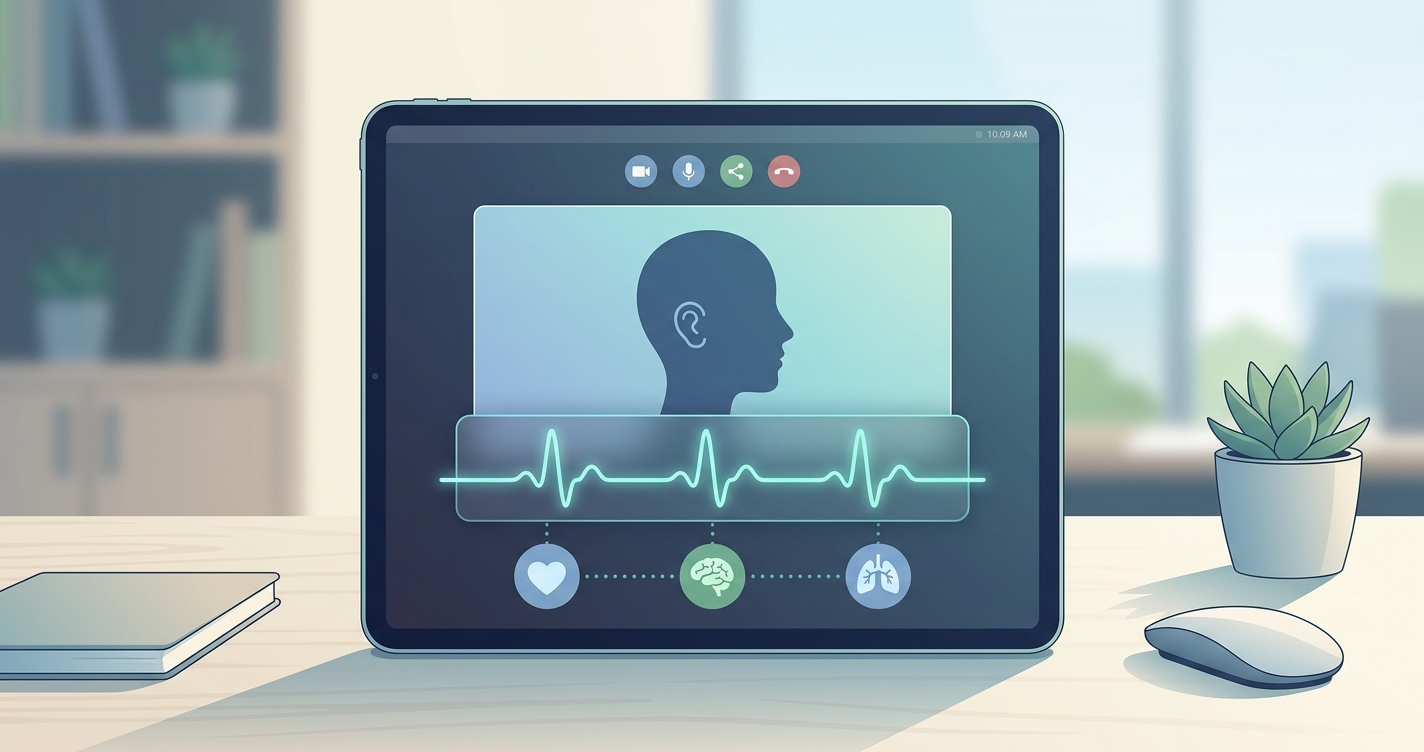
A telehealth video visit captures a clinician's most important diagnostic input, the patient's face and voice, and then throws away the physiological signal hiding inside that same video stream. For most platform teams, the gap is obvious during any chronic-care visit: the provider can see the patient but cannot measure them, so vitals get self-reported, estimated, or skipped entirely. The technical opportunity to add vitals to a telehealth platform comes from the fact that the camera feed already contains enough information to recover heart rate, respiratory rate, and trend-level cardiovascular signals through remote photoplethysmography (rPPG), without shipping a single peripheral device to the patient. This report looks at how IoT and software platforms are layering camera vitals and connected sensors onto existing video-visit workflows, what the integration architecture actually involves, and where the evidence currently stands.
The global contactless vital signs monitoring market is projected to grow from roughly $1.4 billion in 2025 to $4.5 billion by 2035, a compound annual growth rate of 12.3%, according to market analysis published by WiseGuyReports in 2025.
What it means to add vitals to a telehealth platform
When teams say they want to add vitals to a telehealth platform, they usually mean one of two distinct integration patterns, and conflating them is the most common scoping error. The first is contactless camera vitals using rPPG, where a software engine analyzes subtle color changes in facial skin caused by the cardiac pulse wave. The second is IoT health sensor telehealth integration, where connected peripherals such as cuffs, pulse oximeters, or weight scales stream readings into the visit record over Bluetooth or cellular. The two are complementary rather than competing. Camera vitals give you zero-hardware coverage for the broadest patient population, while connected sensors give you regulated-grade measurements for the patients who need them.
The rPPG approach is attractive because it requires no change to what the patient owns. The signal is extracted from the existing webcam or phone camera that the video visit already uses. The work happens in software: a region-of-interest tracker isolates the face, a signal-processing or deep-learning pipeline converts pixel intensity over time into a pulse waveform, and a quality model decides whether the reading is trustworthy enough to surface. Embedded vitals in a video visit therefore become a processing layer, not a procurement line item.
Architecturally, most platforms choose one of three places to run that processing layer. The choice drives latency, privacy posture, and per-visit cost more than any other decision in the build.
| Integration approach | Where processing runs | Hardware required | Latency profile | Best fit |
|---|---|---|---|---|
| Cloud rPPG service | Remote server, video uploaded or streamed | None beyond existing camera | Network-bound, depends on upload | Web-first telehealth with thin clients |
| On-device rPPG SDK | Patient phone, tablet, or browser | Existing camera plus capable CPU/GPU | Low, no round trip | Privacy-sensitive consumer visits |
| Embedded edge engine | Dedicated kiosk, tablet, or clinical hardware | rPPG-capable embedded device | Lowest, deterministic | Clinic-side kiosks and assisted visits |
| Connected IoT peripherals | On the sensor, relayed to platform | BLE/cellular medical devices | Device-dependent | Regulated chronic-care RPM programs |
- Cloud processing minimizes client requirements but sends video off the device, which raises privacy review questions for face data.
- On-device SDKs keep raw imagery local and only emit numeric results, which simplifies the privacy story considerably.
- Embedded edge engines suit the clinic side of a visit, where a kiosk or smart display captures the patient in a controlled setting.
- IoT peripherals remain the path for measurements that demand a validated device, blood pressure being the clearest example.
Industry Applications
Layering camera vitals onto an existing video flow
The least disruptive way to introduce contactless vitals remote monitoring is to treat measurement as a pre-visit or in-visit checkpoint that runs inside the same camera session. A patient joins the waiting room, the platform requests a 30 to 60 second still capture under guidance about lighting and stillness, and the rPPG engine returns heart rate and respiratory rate before the provider connects. Because the capture reuses the video pipeline, the main engineering effort is UX choreography and a results schema, not a new media stack. The Veterans Affairs health system has piloted exactly this pattern, evaluating a smartphone rPPG feature that surfaces real-time vital statistics to both provider and patient during video telehealth visits.
Remote patient monitoring programs
For chronic-care cohorts, platforms combine camera trends with IoT health sensor telehealth integration. The camera handles frequent, frictionless heart-rate and respiratory-rate checks between visits, while a connected cuff or oximeter covers the regulated measurements that reimbursement programs require. This hybrid keeps patient burden low while preserving the device-grade data trail. The remote patient monitoring market in the United States continues to expand on the back of favorable reimbursement, which makes the connected-sensor leg of the architecture financially meaningful, not just clinically useful.
Clinic-side and kiosk-assisted visits
Not every telehealth visit happens from a couch. Retail clinics, employer health rooms, and assisted-living facilities increasingly run video visits from a fixed station. Here an embedded edge engine on a kiosk or smart display captures vitals locally and attaches them to the same visit record the remote clinician sees. This is where embedded rPPG hardware and the software platform converge: the kiosk does deterministic, low-latency capture, and the telehealth platform consumes the result through the same API it would use for a phone-based capture.
Current research and evidence
The evidence base for camera vitals has matured from laboratory demonstrations to applied validation, though it remains uneven across the different vital signs. A 2023 study evaluating a smartphone rPPG application reported heart rate accuracy of about 97% and respiratory rate accuracy near 84% in normotensive adults, with blood pressure estimates in the low-to-mid 90% range under controlled conditions. Heart rate is consistently the most robust output, while blood pressure and oxygen saturation remain harder problems that are sensitive to skin tone, lighting, and calibration assumptions.
Researchers are candid about the failure modes. Reviews of rPPG note that accuracy drops sharply at elevated heart rates, and that motion and poor lighting degrade the signal, which is why a quality-gating model is not optional in production. A 2024 review in Frontiers describing deep-learning advances in contactless physiological measurement points to hybrid RGB and near-infrared capture and better motion-robust networks as the direction of travel for closing those gaps. The same literature flags a standards problem: there is still limited uniformity in how contactless methods are validated, which complicates regulatory positioning for any team trying to add vitals to a telehealth platform at scale.
The practical takeaway for platform architects is to design for graceful degradation. Surface a confidence indicator, fall back to a connected peripheral or manual entry when the quality model rejects a capture, and never present an unvalidated estimate as a clinical-grade number. The systems that handle uncertainty honestly are the ones that survive clinical review.
The future of telehealth vitals integration
Three forces are shaping where this goes next. First, the surrounding markets are growing fast enough to pull integration forward: the telehealth market was valued near $128 billion in 2025 with strong double-digit growth projected, and the IoT in healthcare market is on a trajectory past $1 trillion by 2035 per Future Market Insights. Vitals capture is becoming a default expectation of a video visit rather than a premium add-on.
Second, the processing layer is moving toward the edge. As embedded silicon gets cheaper and more capable, on-device and kiosk-side rPPG reduce both the privacy surface and the per-visit cloud bill, which matters at telehealth volumes. Third, the architecture is converging on a single abstraction: a vitals result object that the platform consumes identically whether it came from a phone camera, a clinic kiosk, or a Bluetooth cuff. Teams that design that abstraction now will be able to swap measurement sources without rebuilding the visit flow.
The platforms that win will treat vitals not as a feature bolted onto video, but as a structured data stream that the video session happens to carry. Getting the integration architecture right, the place processing runs, the quality gating, the privacy boundary, and the result schema, is what separates a demo from a deployment.
Frequently asked questions
Can I add vitals to a telehealth platform without sending patients any hardware? Yes, for the vitals that rPPG supports. Camera-based capture reuses the patient's existing webcam or phone camera, so heart rate and respiratory rate can be measured with no peripheral. Blood pressure and oxygen saturation are better served by connected IoT devices when regulated-grade accuracy is required.
Where should the rPPG processing run? That depends on your priorities. On-device or embedded edge processing keeps raw video local, lowers latency, and simplifies the privacy review because only numeric results leave the device. Cloud processing reduces client requirements but moves face data off-device, which usually triggers a heavier privacy assessment.
How accurate is camera-based vitals capture? Published studies put heart rate accuracy around 97% under controlled conditions, with respiratory rate lower and blood pressure still maturing. Accuracy degrades with motion, poor lighting, and elevated heart rates, so production systems need a quality model that rejects unreliable captures and falls back to another source.
How does IoT sensor integration fit alongside camera vitals? The two are complementary. Camera vitals provide frictionless, frequent checks for the broad population, while connected peripherals supply validated measurements for chronic-care and reimbursement-driven programs. A well-designed platform consumes both through a single vitals result schema.
Circadify is working on this integration problem from the hardware-and-engine side, building an embedded rPPG engine that runs on kiosks, tablets, smart displays, and clinical devices so the same vitals layer can sit behind any video-visit flow. If you are an IoT or platform team scoping how to architect this end to end, see the hardware integration guide at circadify.com/custom-builds/clinical-kiosks.